

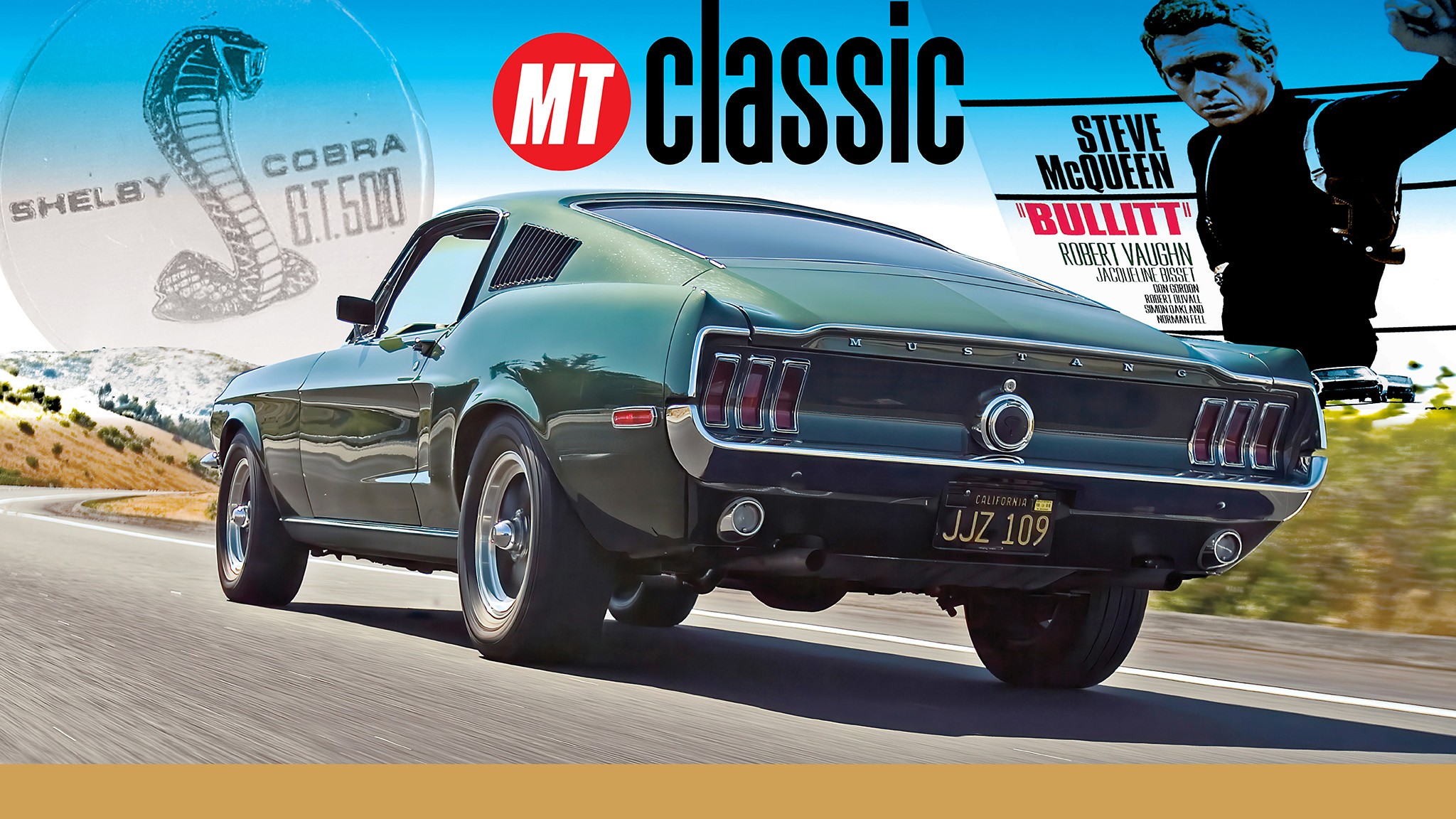

[This story first appeared in the September/October 2006 issue of Motor Trend Classic.] Fact: The chase scene from the 1968 movie Bullitt was, is, and remains the best ever filmed. There have been some valiant challengers: the late John Frankenheimer’s heart-pounding work through the streets of Paris in Ronin; making Minis fly in The Italian Job (the original and the remake); the Seven-Ups, which involved some of the same folks who worked on Bullitt. But when the lists are made and the bets are laid down, Bullitt comes out on top. Every time.
In spite of a few charming continuity goofs and cameras occasionally visible in the back seat of Lieutenant Frank Bullitt’s tire-smoking Mustang fastback, the scene was lauded for its authenticity and realism at the time. See it on a big screen today, and the views out the windshield as the Mustang and bad guys’ Dodge Charger careen down San Francisco’s Taylor Street will still make your stomach roll.
Our mission was to return to the City by the Bay in a faithfully recreated replica of the Bullitt Mustang, drive the chase-scene route, and hit a few other iconic locales used during filming.
The Flick
Any car fool worth his tweed blazer and blue turtleneck will be familiar with the movie and the great chase, but if not, here’s a quick rundown: Steve McQueen plays Frank Bullitt, a grizzled veteran investigator with the San Francisco P.D. His girlfriend is the nubile Jacqueline Bisset, and the reptilian politico villain is played by Robert Vaughn at his best. You’ll spot worthy performances by Norman Fell and McQueen pal Don Gordon, and a young Robert Duvall cameos as a cab driver. Brit Peter Yates directed. From its earliest iterations, the script called for an “automotive action scene”; this was likely one of the reasons McQueen and his Solar Productions were involved in the first place. The actor insisted on absolute realism, with no camera speedups, and of course this was long before the notion of computer-generated animation. The rest of the plot is inconsequential to this exercise.
Ford was the official car provider for the movie, the main four-wheeled characters being two 1968 Mustang GT 390s, painted that now famous shade of Highland Green Metallic. The cars carried back-to-back serial numbers, and although rumors persist that one was really a 302-powered car and one had an automatic trans, hard-core Bullitteers have vetted the build codes and confirm both were 325-horse, big-block, four-speed models.
The apartment building Frank Bullitt calls home.
Race-car driver and constructor legend Max Balchowsky (of Old Yeller fame) was called upon to modify the cars for heavier-than-routine duty. Suspensions were beefed up, as were their pickup points. Koni adjustable shocks were installed, along with numerous camera mounts. The stock exhaust systems retained their small glasspack mufflers,