

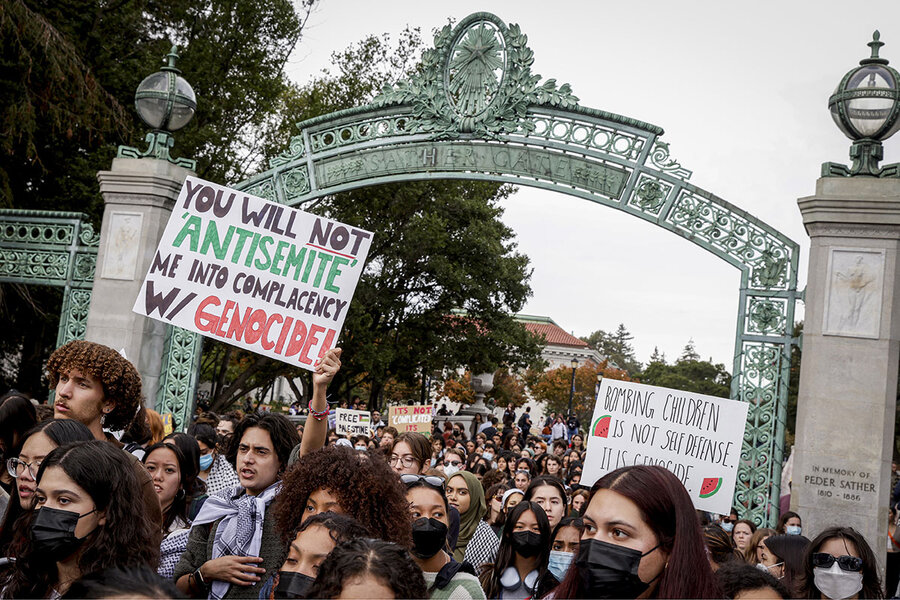

A surge of student activism has shaken college campuses across the United States since Oct. 7, when Hamas militants carried out a brutal attack in southern Israel, resulting in the deaths of 1,200 civilians and the capture of over 200 hostages.
While there are some young individuals who have expressed support for Israel in response to its military actions against Hamas, the suffering of Palestinians in Gaza, with an estimated 17,000 casualties according to Gaza officials, has spurred many more to participate in protests, demonstrations, and sit-ins.
Why We Wrote This
A generational divide over Israel has roiled college campuses and led to the resignation of one Ivy League president. For many, views about the conflict reflect the context in which they came of age.
Surveys indicate a generational split on this issue. While older Americans remember Israel as a vulnerable entity in a hostile region, fending off Arab armies in the 1960s and ’70s, today’s college students have come of age in a different era – one marked by pandemic disruptions and the racial justice protests of 2020. Many student activists view the struggles of Palestinians as resembling those of Black victims of police violence, accusing Israel of “structural racism” in its “occupation” of Palestinian territories.
“For a lot of younger activists, they’ve seen Israel mostly in the context of the occupation of the West Bank and Gaza,” says Thomas Zeitzoff, an associate professor of public affairs at American University. “Israel is seen as just a much stronger actor.”
Selena Lacayo’s Arrest
When campus police removed Selena Lacayo from a pro-Palestinian sit-in on the night of Oct. 25, it was her first arrest. She was one of 56 students and one employee at the University of Massachusetts Amherst who were later charged with trespassing outside the chancellor’s office.
However, this was not Ms. Lacayo’s first protest. Last spring, she participated in a march with other students to demand the removal of the university’s police force from campus under the banner of prison abolition.
To Ms. Lacayo, a first-generation college senior majoring in women, gender, and sexuality studies, resisting the “prison-industrial complex” and Israeli military actions in Gaza is all part of the same struggle. The common enemy is “Western imperialism” that, as she sees it, oppresses people in formerly colonized countries and those living in marginalized communities.
Why We Wrote This
A generational divide over Israel has roiled college campuses and led to the resignation of one Ivy League president. For many, views about the conflict reflect the context in which they came of age.
She believes it is essential for U.S. students who “have been directly affected by war and militarism” to organize and defend their rights.
Her protest was part of a wave of Israel-related student activism that has roiled campuses across the U.S. since Oct. 7, when Hamas militants massacred 1,200 civilians in southern Israel. While some young people have voiced solidarity with Israel and supported its retaliation against Hamas,