


If there had been any doubt — and there shouldn’t have been — that a massive restructuring was coming for college athletics, June 21, 2021, should have ended such illusions.
That’s when U.S. Supreme Court Justice Brett Kavanaugh issued a blistering concurring opinion to a case that the NCAA had just lost 9-0. That one — NCAA v. Alston — allowed student-athletes to receive any academic award money they might earn.
It was a simple case, but Kavanaugh used it to warn College Sports Inc. that it should fix its issues internally because if it came back to the Supreme Court arguing for the preservation of, well, pretty much anything, it was unlikely to find much sympathy.
“I add this concurring opinion to underscore that the NCAA’s remaining compensation rules also raise serious questions under the antitrust laws,” Kavanaugh wrote.
He said the NCAA’s argument about “amateurism” was “circular and unpersuasive” and merely a clever label to fix costs and control labor, both of which he signaled would be deemed illegal.
“Price-fixing labor is price-fixing labor,” Kavanaugh continued later. “And price-fixing labor is ordinarily a textbook antitrust problem.”
In other words, college athletics has been a lot of fun through the years, but its old model stood no chance with this new court. Whether administrators, coaches or fans wanted it, liked it or approved of it, the status quo was doomed.
Athletes as employees, revenue sharing, schools issuing contracts and, perhaps, a winnowing of the number of teams capable of competing, at least in football, was coming.
“The NCAA is not above the law,” Kavanaugh wrote.
However, rather than getting serious about serious questions, college sports leaders kept trying through the NCAA to fight a fight they were doomed to lose — focusing on establishing outdated “guardrails” and minor tweaks, fruitlessly lobbying Congress to save them and decrying the transition as the “Wild, Wild West,” like their feelings mattered.
Then, finally, came Friday — more than 2 1/2 years after Kavanaugh essentially warned that the NCAA needed to solve “some difficult policy and practical questions” or else the Supreme Court would.
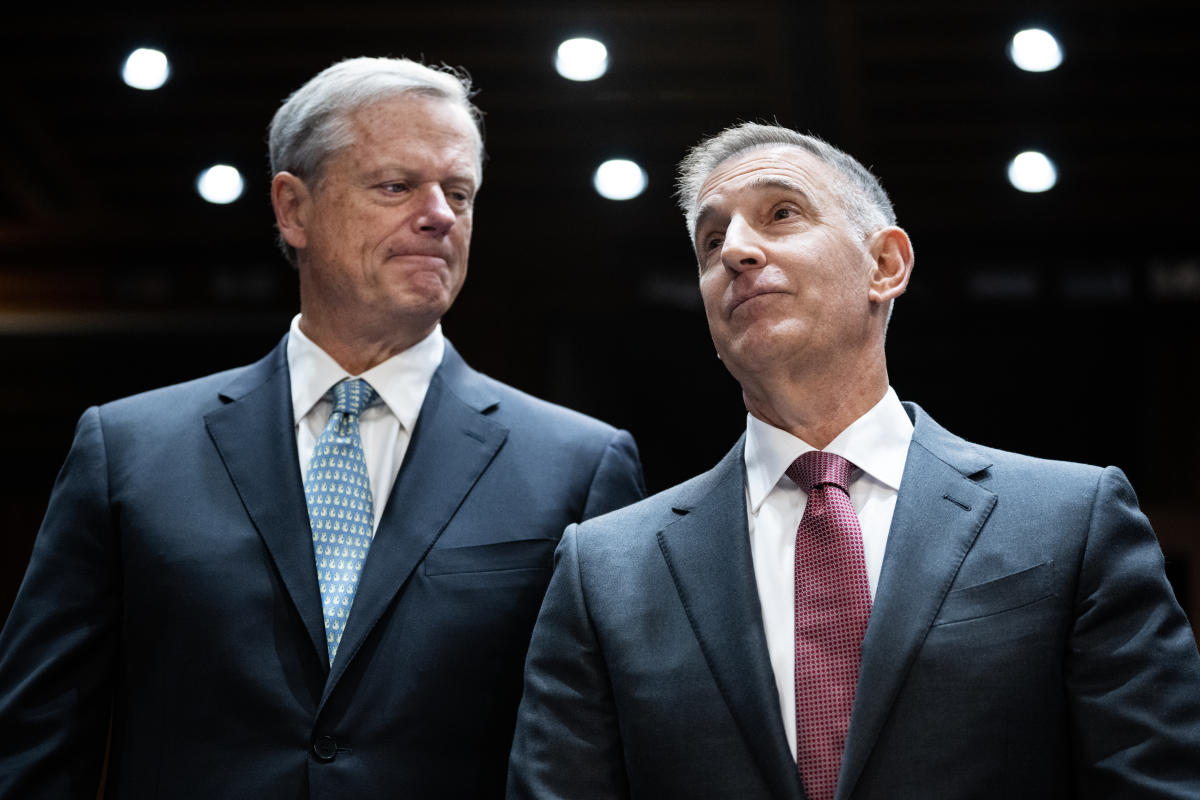
NCAA president Charlie Baker (left) had his own proposal to solve college sports’ issues with “Project DI.” Big Ten commissioner Tony Petitt (right) and SEC commissioner Greg Sankey may have other opinions. (Tom Williams/Getty Images)
The Big Ten and the SEC — the two behemoth conferences of college sports – formed “a joint advisory group … to address the significant challenges facing college athletics and the opportunities for betterment of the student-athlete experience.”
The group has no authority to enact change and is only “a consulting body,” but make no mistake, it can quickly morph into a new NCAA. After too much stalling and too many opinions, a smaller group of the biggest stakeholders are going to make some decisions because someone must and time is ticking.