

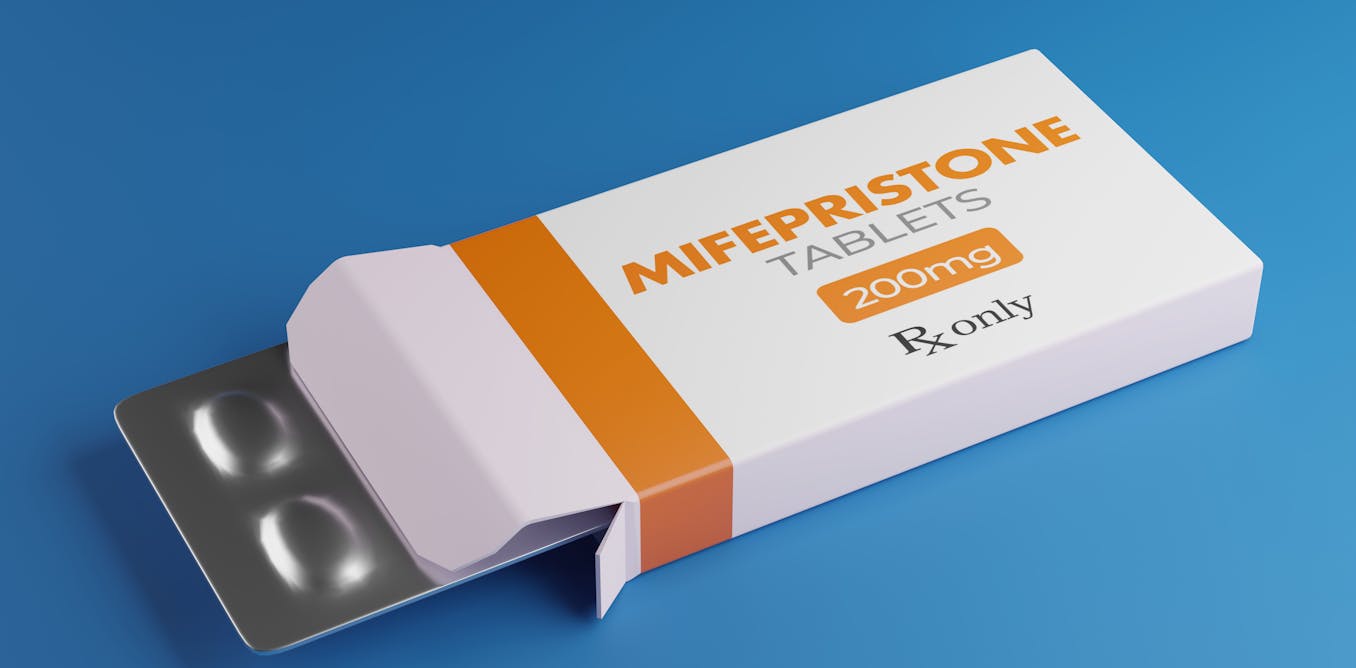

The U.S. Supreme Court has decided that patients can continue to get mifepristone, one of the two drugs used for medication abortion, via telehealth and by mail. At least for now.
A lower court had temporarily blocked this access nationwide in early May 2026. The case now returns to that lower court, although it may well make it back to the Supreme Court in the future.
Since 2023, almost two-thirds of abortions in the United States have involved mifepristone, and since late 2024 one-quarter of all abortions occur through abortion pills provided via telehealth.
As scholars who study laws affecting reproductive health, we believe the outcome of this case will have an enormous impact on access to abortion care across the country.
In states with abortion bans, telehealth prescriptions have allowed women to get abortions anyway. But the case is also significant to those in states without abortion bans, especially women with low incomes and disabilities or who live in rural areas, where reproductive services are extremely limited.
How did the case get to this point?
The case began in October 2025, when Louisiana argued that the Biden administration’s allowance of telehealth abortions was for “avowedly political reasons.” The state asserted that the U.S. Food and Drug Administration had insufficient evidence to remove the requirement that the drug be dispensed in person, which had been in place from 2000 through 2021.
The state also argued that mailing mifepristone violated an 1873 federal law known as the Comstock Act. This law, which makes it a crime to mail or ship any “lewd, lascivious, indecent, filthy or vile article” and anything that “is advertised or described in a manner … for producing abortion,” has rarely been enforced.
The lower court thought Louisiana would likely win, but it decided to keep the FDA regulations in place while the case made its way through the courts. On May 1, 2026, however, the appellate court suspended the FDA regulation allowing mifepristone to be prescribed via telehealth.
As a result, mifepristone could no longer be mailed or prescribed via telehealth, nationwide. Three days later, on May 4, after the manufacturers of mifepristone appealed, the Supreme Court put the 5th U.S. Circuit Court of Appeals’ decision on hold for a week to give it more time to consider the legal issues. On May 11, it extended the stay for a few more days.
What does the SCOTUS decision mean for mifepristone access?
On May 14, the Supreme Court decided to leave the FDA’s regulation in effect, so mifepristone remains available for prescription via telehealth. Justices Samuel Alito and Clarence Thomas dissented, with Alito accusing the court of “perpetrat[ing] a scheme to undermine” the court’s decision in the 2022 Dobbs ruling that overturned the constitutional right to an abortion and allowed states to ban it. Thomas added his view that the Comstock Act makes it a criminal offense to mail mifepristone.