


Brain-Computer Interfaces Are Advancing, But Is The NeuroRights Movement Keeping Up?
By
Fletcher Reveley / Undark
|
Published Jan 3, 2024 3:00 PM EST
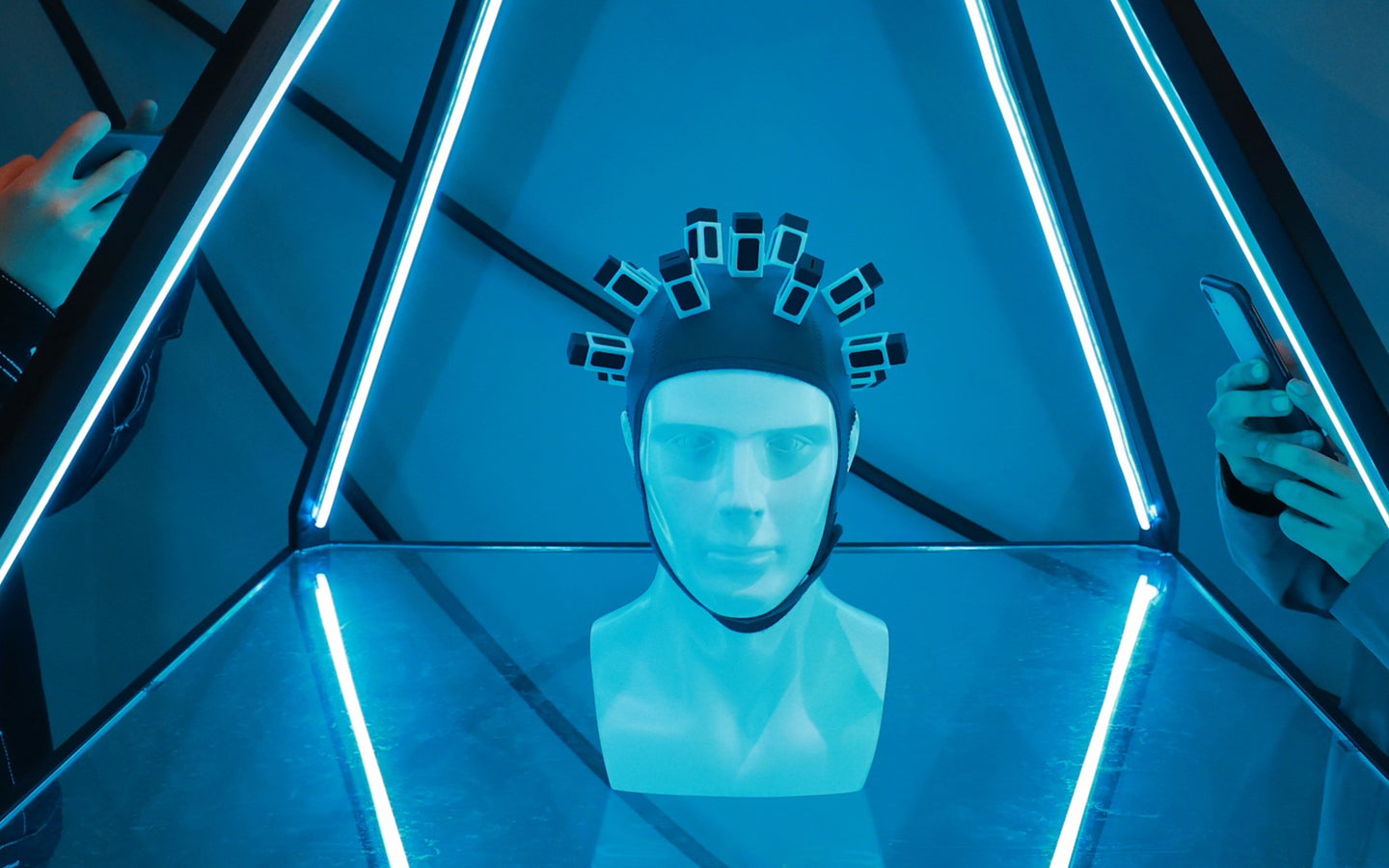
Some scientists worry that not enough attention is being paid to the ethics of brain-computer interfaces. Chen Xiaogen/VCG via Getty Images
SHARE
This article was originally featured on Undark.
One afternoon in May 2020, Jerry Tang, a Ph.D. student in computer science at the University of Texas at Austin, sat staring at a cryptic string of words scrawled across his computer screen:
“I am not finished yet to start my career at twenty without having gotten my license I never have to pull out and run back to my parents to take me home.”
The sentence was jumbled and agrammatical. But to Tang, it represented a remarkable feat: A computer pulling a thought, however disjointed, from a person’s mind.
For weeks, ever since the pandemic had shuttered his university and forced his lab work online, Tang had been at home tweaking a semantic decoder—a brain-computer interface, or BCI, that generates text from brain scans. Prior to the university’s closure, study participants had been providing data to train the decoder for months, listening to hours of storytelling podcasts while a functional magnetic resonance imaging (fMRI) machine logged their brain responses. Then, the participants had listened to a new story—one that had not been used to train the algorithm—and those fMRI scans were fed into the decoder, which used GPT1, a predecessor to the ubiquitous AI chatbot ChatGPT, to spit out a text prediction of what it thought the participant had heard. For this snippet, Tang compared it to the original story:
“Although I’m twenty-three years old I don’t have my driver’s license yet and I just jumped out right when I needed to and she says well why don’t you come back to my house and I’ll give you a ride.”
VS
The decoder was not only capturing the gist of the original, but also producing exact matches of specific words—twenty, license. When Tang shared the results with his adviser, a UT Austin neuroscientist named Alexander Huth who had been working towards building such a decoder for nearly a decade, Huth was floored. “Holy shit,” Huth recalled saying. “This is actually working.” By the fall of 2021, the scientists were testing the device with no external stimuli at all—participants simply imagined a story and the decoder spat out a recognizable, albeit somewhat hazy, description of it. “What both of those experiments kind of point to,” said Huth, “is the fact that what we’re able to read out here was really like the thoughts, like the idea.”
The scientists brimmed with excitement over the potentially life-altering medical applications of such a device—restoring communication to people with
» …
Read More
rnrn