

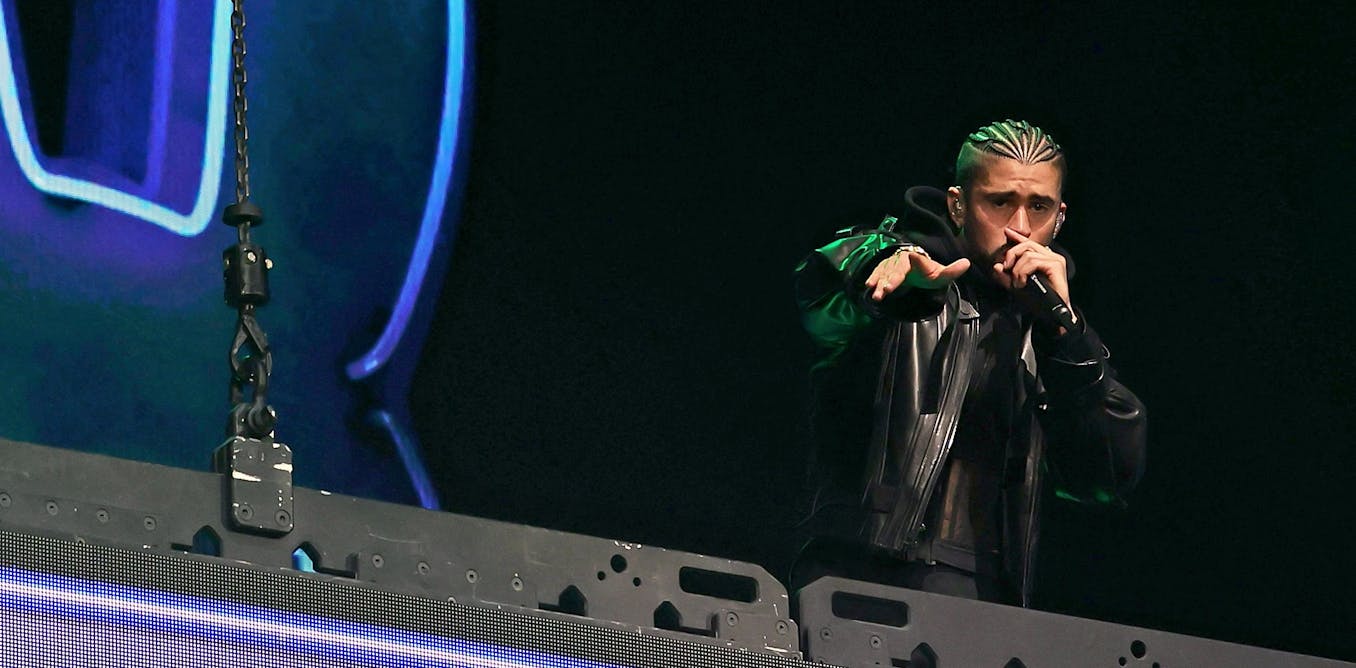

Soon after the NFL’s announcement that Puerto Rican rapper Bad Bunny would headline the Super Bowl halftime show, conservative media outlets and Trump administration officials went on the attack.
Homeland Security head Kristi Noem promised that U.S. Immigration and Customs Enforcement “would be all over the Super Bowl.” President Donald Trump called the selection “absolutely ridiculous.” Right-wing commentator Benny Johnson bemoaned the fact that the rapper has “no songs in English.” Bad Bunny, conservative pundit Tomi Lahren complained, is “Not an American artist.”
Bad Bunny – born Benito A. Martínez Ocasio – is a superstar, one of the top-streaming artists in the world. And because he is Puerto Rican, he’s a U.S. citizen, too.
To be sure, Bad Bunny checks many boxes that irk conservatives. He endorsed Kamala Harris for president in 2024. There’s his gender-bending wardrobe. He has slammed the Trump administration’s anti-immigration policies. He has declined to tour on the U.S. mainland, fearing that some of his fans could be targeted and deported by ICE. And his explicit lyrics – most of which are in Spanish – would make even the most ardent free speech warrior cringe.
And yet, as experts on issues of national identity and U.S. immigration policies, we think Lahren’s and Johnson’s insults get at the heart of why the rapper has created such a firestorm on the right. The spectacle of a Spanish-speaking rapper performing during the most-watched sporting event on American TV is a direct rebuke of the Trump administration’s efforts to paper over the country’s diversity.
The Puerto Rican colony
Bad Bunny was born in 1994 in Puerto Rico, an unincorporated U.S. territory that the country acquired after the 1898 Spanish-American War.
It is home to 3.2 million U.S. citizens by birth. If it were a state, it would be the 30th largest by population, according to the 2020 U.S. Census.
But Puerto Rico is not a state; it is a colony from a bygone era of U.S. overseas imperial expansion. Puerto Ricans do not have voting representatives in Congress, and they do not get to help elect the president of the United States. They are also divided over the island’s future. Large pluralities seek either U.S. statehood or an enhanced form of the current commonwealth status, while a smaller minority vie for independence.
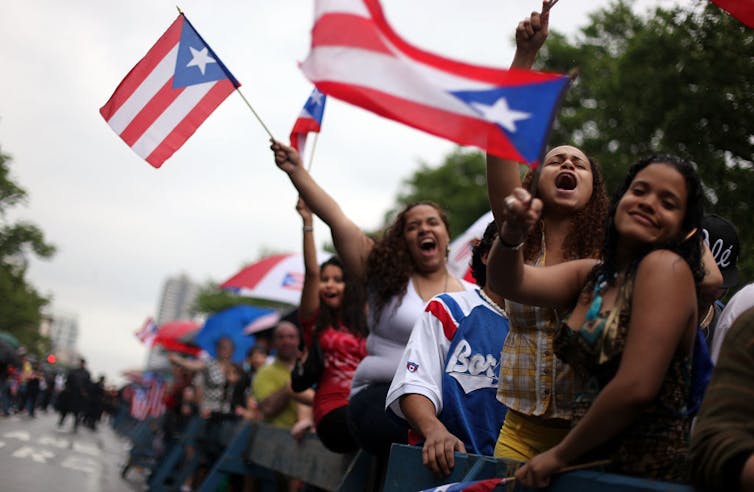
Revelers in New York’s Spanish Harlem wave Puerto Rican flags during the neighborhood’s annual 116th street festival.
Mario Tama/Getty Images
But one thing is clear to all Puerto Ricans: They’re from a nonsovereign land, with a clearly defined Latin American culture – one of the oldest in the Americas. Puerto Rico may belong to the U.S. – and many Puerto Ricans embrace that special relationship – but the island itself does not sound or feel like the U.S.
The over 5.8 million Puerto Ricans that reside in the 50 states further complicate that picture. While legally they are U.S.