

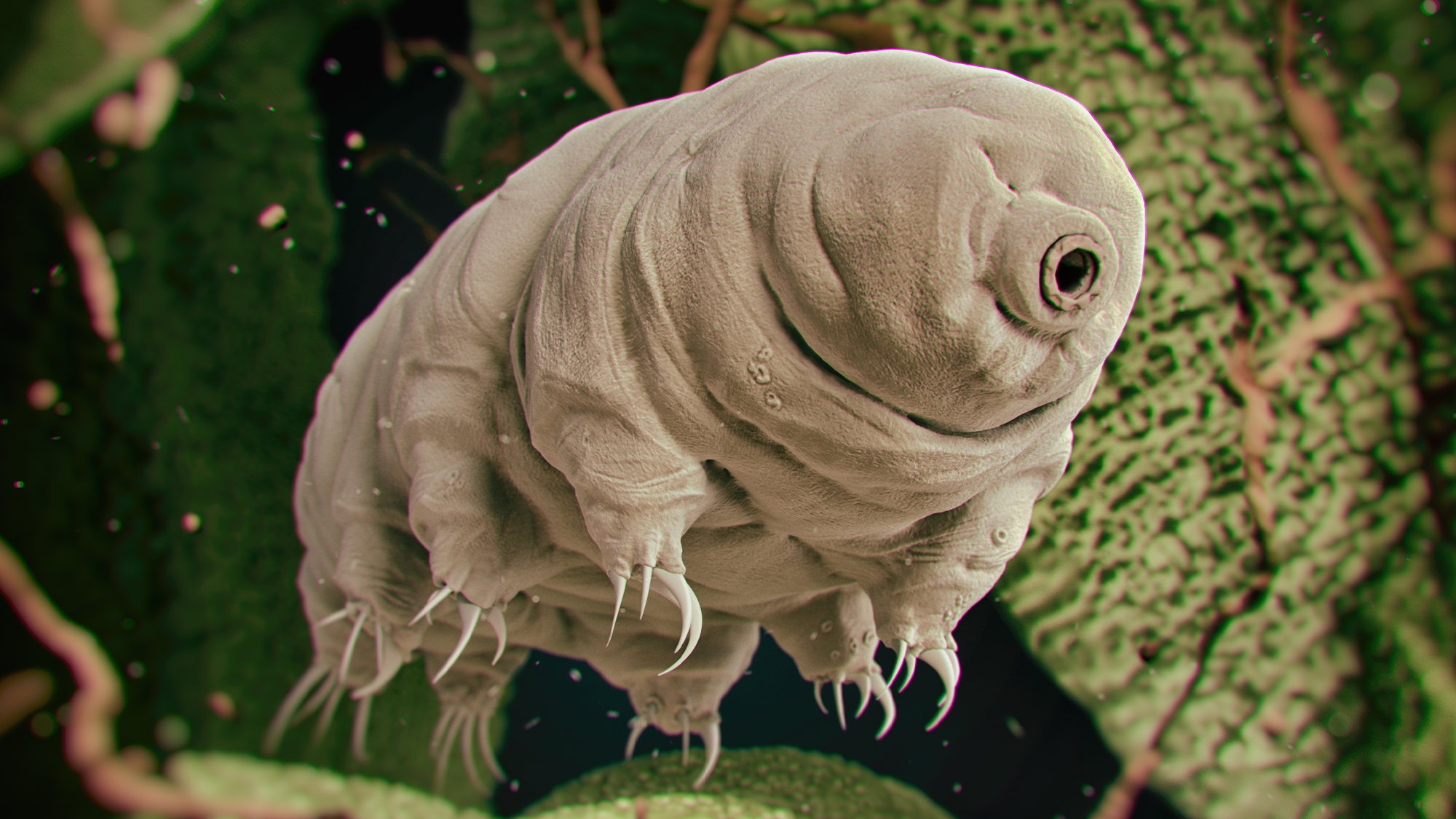

Tardigrades, also known as “water bears”, are some of the toughest animals on the planet. Unlike other creatures, tardigrades can survive in environments with extreme temperatures, without water or oxygen. Recently, scientists may have pinpointed the precise molecular mechanism the tiny invertebrates use to survive such intense conditions. They discovered that tardigrades have a molecular sensor that can detects uninhabitable elements in their environment, allowing them to go dormant and resume their normal activities as needed. The findings are described in a study published January 17 in the open-access journal PLOS ONE.
Want to learn more about tardigrades? Check out our article: Tardigrades go where the slime takes them.
So, what is a tardigrade?
There are more than 1,100 species of tardigrade. These free-living invertebrates are considered close relatives of arthropods. They are about 0.04 inch or less in size and live in a variety of habitats, from flowering plants to the ocean.
Some tardigrades are plant-eaters, piercing individual plant cells with their stylets and suck out the cell’s contents for sustenance, while others are carnivorous and eat other small invertebrates.
German zoologist J.A.E. Goeze was the first to observe tardigrades through a microscope in 1773 and recorded that its body looked like a shriveled and shrunken version of a bear. He named it kleiner Wasserbär, which is German for “little water bear.”
How do they survive extreme environments?
When faced with dry, barren, and otherwise inhospitable environments, tardigrades go dormant and enter a tun state. In this state, their eight legs retract, their bodies become dehydrated, and their metabolism slows down to an almost undetectable level. They essentially curl up into a ball and can remain in this state for years.
Researchers of this new study were able to trigger dormancy in tardigrades by exposing them to extreme temperatures or high levels of hydrogen peroxide, salt, or sugar in a lab. The team found that the tardigrades’ cells produced damaging oxygen free radicals in response to these harmful conditions which then reacted with an amino acid called cysteine. The reactions caused the water bears to go into a dormant state.
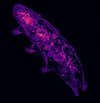 Tardigrade observed using a confocal fluorescent microscope. The tardigrade was overexposed to 5-MF, a cysteine selective fluorescent probe, that allows for visualization of internal organs. CREDIT: Smythers et al., 2024, PLOS ONE, CC-BY 4.0
When the conditions improve and the free radicals are gone, the sensor is no longer oxidized and the tardigrades re-emerge from their dormancy. Blocking the cysteine in their environment prevented the water bears from detecting the free radicals and entering dormancy.