

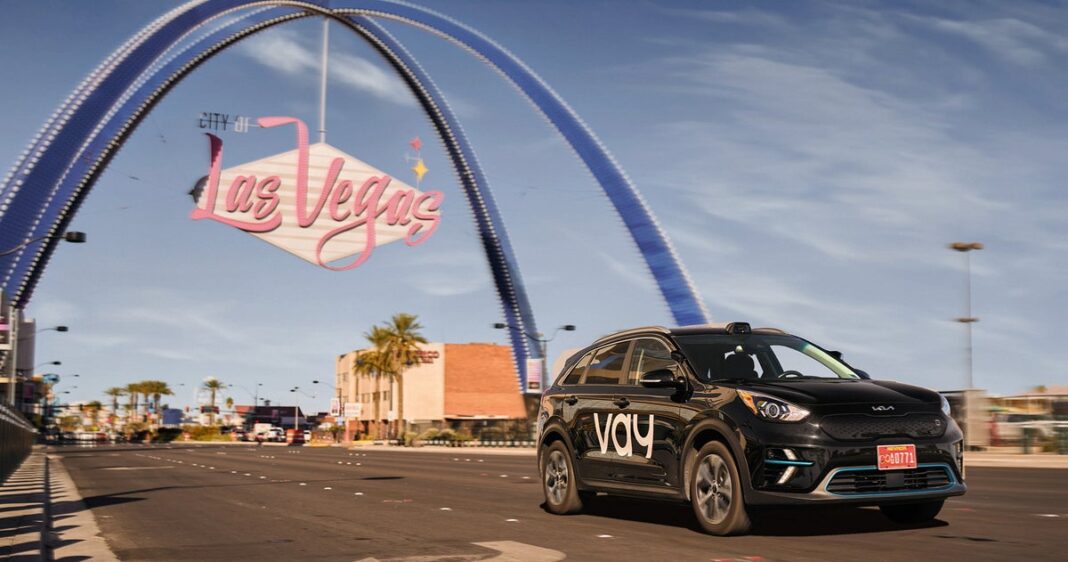
Tourists and locals wandering near the Las Vegas strip this year will now see a new a fleet of SUVs mysteriously zooming across town without anyone in the driver’s seat. These vehicles, operated by German startup Vay, may not have humans grasping at the steering wheel but they also aren’t exactly the fully autonomous driverless cars of science fiction fame. In reality, the Vay cars are part of the emerging “teledriving” model where human operators use video-game-like remote controls to steer cars towards customers from the company’s headquarters.
What is teledriving?
Teledriving companies like Vay claim they can alter metropolitan mobility and one day reduce the number of cars filling city streets through the use of remote control drivers. Customers interested in using one of the vehicles request a ride on a mobile app. A team of human operators at Vay then use a combination of cameras, sensors and augmented reality tech to remotely drive a vehicle to the customer. Once the car arrives, the customers take over control and drive it to their destination with a fee based on time spent driving. When the trip is complete, the remote driver regains control over the vehicle and drives it to a new customer. PopSci has reached out to Vay to clarify what happens to the vehicles between trips and overnight.
Vay launched the first commercial teledriving product in the US last week in parts of Las Vegas, previously allowing for early access test drives. The company is operating its remote controlled car service near the city’s Arts District and the University of Nevada, which is nestled around a mile away from the famous strip. Users who take over the cars from the remote drivers are charged $.30 per minute while driving and $.03 per minute if they decide to momentarily park the car to go shopping or pick up groceries.
The remote drivers at Vay operate the vehicles using a simulated driving station that looks like an advanced version of an arcade car game equipped with a physical steering wheel and pedals. A large screen reproduces the vehicle’s real-world surroundings using a combination of sensors and cameras. This is all made possible by modern 5G wireless networks, which let the vehicles quickly transmit real-time data to the remote operators.
Vay isn’t the only startup trying to carve out a lane in the teledriving space but it’s the first to operate commercially in the US. Elmo, another major player in the space, recently received approval to operate in Lithuania. Together, these companies are hoping to attract commuters who want to save time parking vehicles and avoid the maintenance costs and responsibilities of owning a vehicle. Supporters of these shared, all-electric ride services say they could also help cut back on commuters’ carbon footprints by reducing the overall number of vehicles on the road. In 2021, the Environmental Protection Agency estimated around 29% of US greenhouse gas emissions were attributed to transportation,