

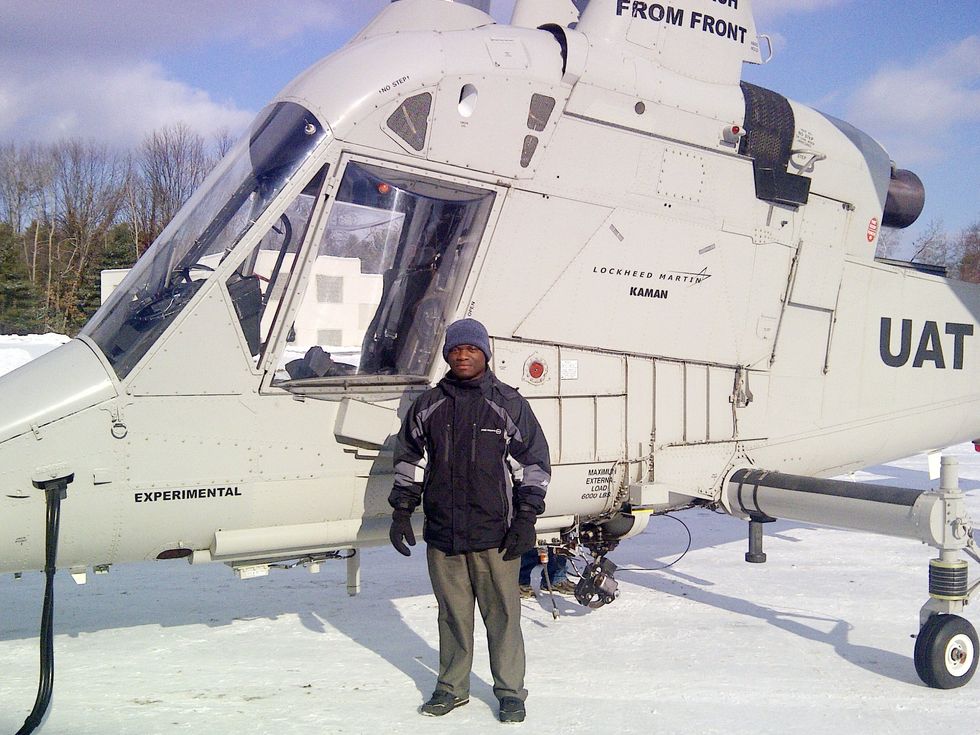

Kingsley Fregene wants to keep people out of harm’s way—so much so that he has ordered his life around that fundamental goal. As director of technology integration at Lockheed Martin, in Grand Prairie, Texas, he leads a team that is actively pursuing breakthroughs designed to, among other things, allow life-saving missions to be performed in hazardous environments without putting humans at risk.
He has supervised the development of algorithms for autonomous aircraft used for military missions and disaster-recovery operations. He also contributed to algorithms enabling autonomous undersea vehicles to inspect offshore oil and gas platforms after hurricanes so that divers don’t have to.
Kingsley Fregene
Employer
Lockheed Martin in Grand Prairie, Texas
Title
Director of technology integration and intellectual property
Member grade
Fellow
Alma maters
Federal University of Technology in Owerri, Nigeria; University of Waterloo in Ontario, Canada
One of his recent projects was helping to design the world’s first autonomous unmanned aircraft system in which the entire vehicle—not just its rotors—spins. The micro air vehicle was inspired by the aerodynamics of maple seeds, whose twirling slows and prolongs their descent.
The benefits of unmanned aerial vehicles
In a major project more than a decade ago, Fregene and colleagues at Lockheed Martin teamed up with Kaman Aerospace of Bloomfield, Conn., on an unmanned version of its K-Max helicopter. The K-Max can ferry as much as 2,700 kilograms of cargo in a single trip. The Lockheed team created and implemented mission systems and control algorithms that augmented the control system already on the helicopter, enabling it to fly completely autonomously.
The U.S. Marine Corps used the autonomous K-Max helicopters for resupply missions in Afghanistan. It’s been estimated that those delivery flights made hundreds of ground-based convoy missions unnecessary, thereby sparing thousands of troops from being exposed to improvised explosive devices, land mines, and snipers.
The autonomous version of the K-Max also has been demonstrated in disaster-recovery operations. It offers the possibility of keeping humanitarian aid workers away from dangerous situations, as well as rescuing people trapped in disaster zones.
“It is often better to fly in lifesaving supplies instead of loading trucks with supplies to bring them along roads that might not be passable anymore,” Fregene says.
K-Max and one of Lockheed Martin’s small UAVs, the Indago, have been used to fight fires. Indago flies above structures engulfed in flames and maps out the hot zones, on which K-Max then drops flame retardant or water.
“This collaborative mission between two of our platforms means no firefighters are put in harm’s way,” Fregene says.
He and his team also helped in the development of the maple seed–inspired Samarai, the first autonomous wholly rotating unmanned aircraft system. The 41-centimeter-long drone weighs a mere 227 grams.