


The recent opening of an immigration centre in El Paso, Texas, has reignited protests of the Trump administration’s tough immigration plans from Japanese Americans. The internment camp, which opened in August 2025, is on the site of a military base that was used to intern Japanese Americans during the war.
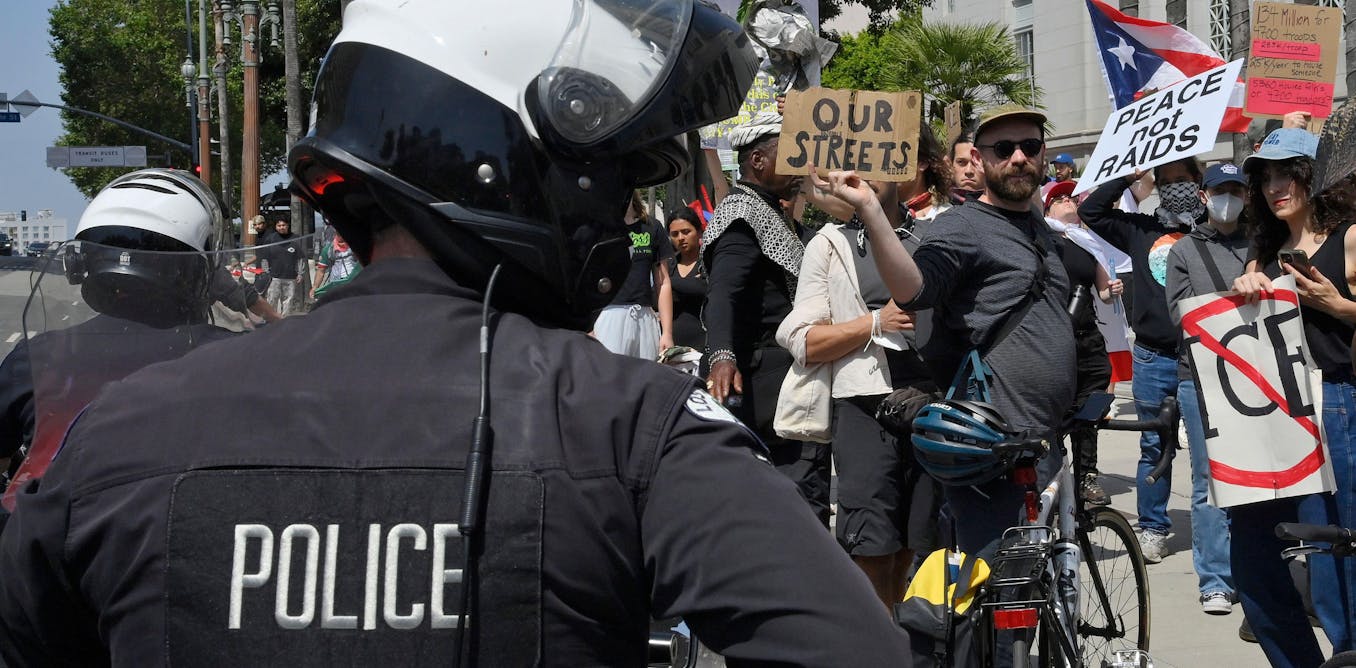
In the past few months hundreds of Japanese Americans have been protesting the construction of new immigration centres and plans to detain thousands of people by the US Immigration and Customs Enforcement unit (Ice), because it stirs up memories of how their families were rounded up during the second world war.
The US government has also invoked the 1798 Alien and Enemies Act, last used in the second world war, to increase the powers of Ice to detain individuals.
Much of the basis for the internment of Japanese Americans during the war was derived from the 1798 act, which allows the detention and deportation of foreign “enemies”.
Dublin prison, near San Francisco, was closed in 2024 but Ice is seeking to reopen it – and many other detention sites – to keep up with Donald Trump’s ambitious plan to arrest large numbers of immigrants.
The Japanese American community came out to protest in July around Dublin, outlining fears that the recent Ice raids are a repeat of the history that led to the incarceration of more than 120,000 Japanese Americans between 1942 and 1946. One internal Ice estimate suggests there are currently 60,000 immigrants held in detention throughout the US.
Latino neighbourhoods are being targeted, according to civil rights groups, although the Department of Homeland Security has denied it is targeting groups based on their skin colour or ethnicity.
One protester, Lynn Yamashita, said to ABC News: “I’m here because the Japanese were interned, my father was interned, and it can’t happen again – but it is happening, it’s shameful.” Douglas Yoshida, another protester, said: “There’s no invasion, but Trump has cited the Alien Enemies Act to detain and deport people without any due process.”
The Japanese American community in California has been quick to draw comparisons between the alleged targeting of Latino communities by Ice and their own treatment during the second world war. This attracted particular national attention when scores of masked and armed federal agents turned up and arrested a person outside the Japanese American National Museum (JANM) in Los Angeles, during a speech by California’s governor, Gavin Newsom.
This is a highly symbolic site, as it is where Japanese American families were forced to board buses to American concentration camps in 1942. JANM has posted pictures comparing the cramped conditions in those WWII camps to the cages being used in Ice detention facilities. In both cases, families were ripped apart, causing huge amounts of trauma.
What is the history?
In the decades before the second world war, various pieces of legislation were passed to halt both Chinese and Japanese immigration to the US,