


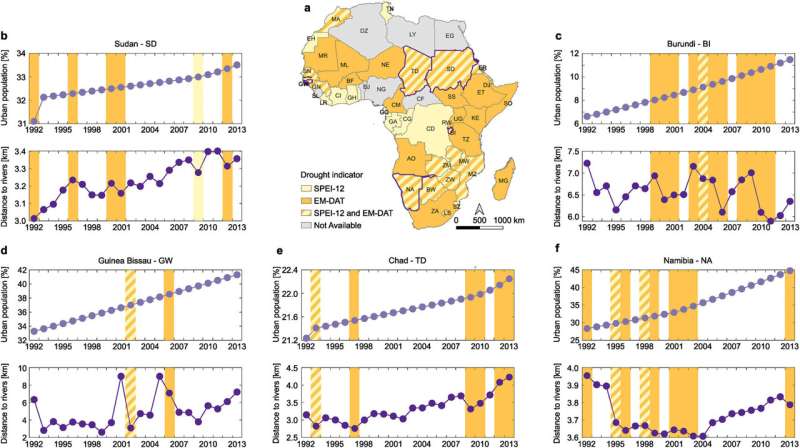
Drought occurrence and variations in human settlement patterns for representative countries within the UN subregions for Africa. Credit: Earth’s Future (2023). DOI: 10.1029/2023EF003510
In 80% of African countries, human settlements move toward rivers and into cities during drought, increasing the number of people living in flood-risk areas in recent decades, according to a recent study. This resettlement pattern will likely intensify in coming decades as climate change is expected to make droughts more frequent and severe.
“It’s a cycle that exacerbates how many people are negatively impacted by drought, and not only in the ways we might normally expect,” said Serena Ceola, a hydrologist at the University of Bologna in Italy who led the study. “As regional climates change and both droughts and floods become bigger problems, more people will struggle to find a safe place to settle. People may move from one drought-affected place to another or move somewhere that just poses different climate risks.”
In Somalia, for example more than 3.8 million people have been displaced in part by drought over the last three years. Many of those climate refugees sought shelter near rivers, where farming could resume, but heavy rains and flash floods then displaced more than half a million people.
The study was published in the journal Earth’s Future. Prior to this study, research on drought-driven migrations in Africa focused on single countries or specific drought events, limiting scientists’ understanding of how drought influences patterns of human settlements at large scales. The new study is the first to examine changes in human settlement patterns associated with droughts on a continental scale.
“We want the whole society to be aware of just how many people are moving from one climate threat to another,” Ceola said.
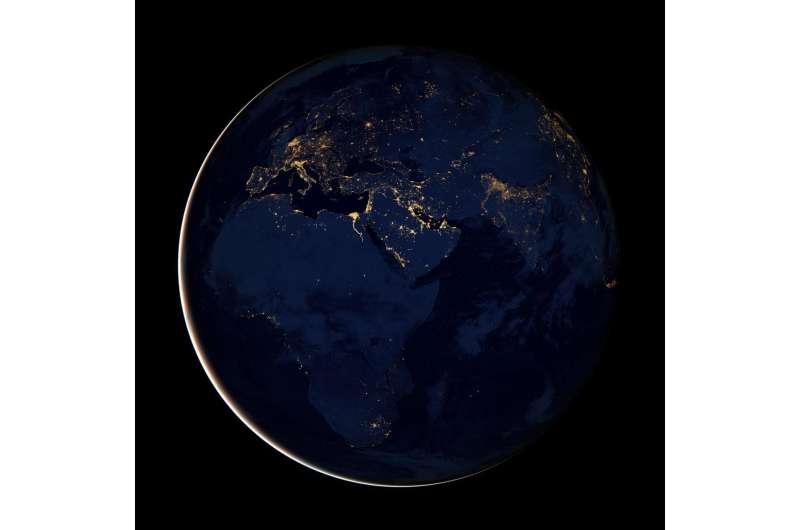
Nighttime lights can be used to tell where people have settled. Credit: NASA Goddard
Untangling drought
Droughts may push people closer to rivers to continue agricultural activities, and others may adapt by moving to cities, which offer diverse economic opportunities when drought limits agriculture. Scientists have hypothesized that drought can be a main driver of human displacement, but many factors—often inextricably linked to drought itself—can contribute to displacement. Drought can exacerbate conflict, political violence and food and job insecurity, each of which can prompt mass migrations on their own.
The researchers chose to focus on drought alone due to its potential impact on many different factors. They used two indices, EM-DAT and SPEI-12, which respectively reflect socioeconomic and evapotranspiration impacts of drought, to look for droughts in 50 African countries from 1992 to 2013. They included in their analyses the years preceding and following the drought to test for strength of the drought signal and lingering effects of drought on human movement.
To determine whether people moved to rivers, the researchers used satellite-based nighttime light detection to check for either changes in existing settlements’ luminosities or the development of new settlements.