


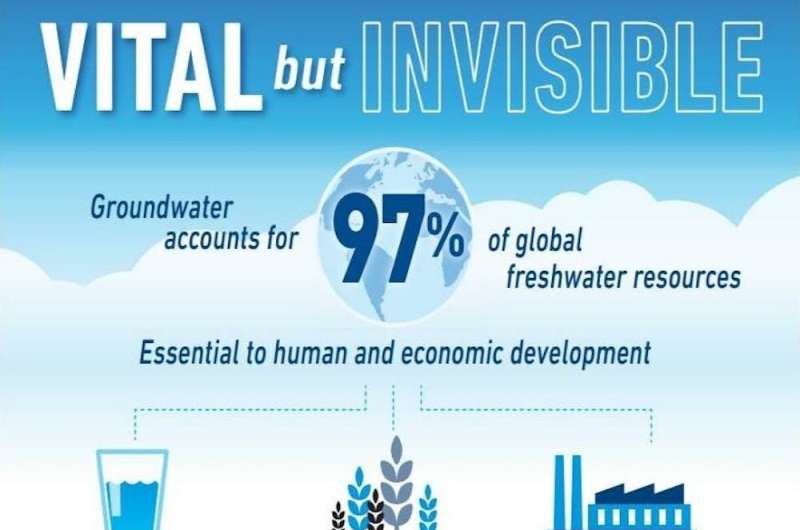
Groundwater, more valuable than you think. Credit: World Bank, CC BY-ND
If you stand at practically any point on Earth, there is water moving through the ground beneath your feet. Discover more about groundwater here providing about half of the world’s population with drinking water and nearly half of all water used to irrigate crops. It sustains rivers, lakes, and wetlands during droughts.
Groundwater is a renewable resource, but it can take decades or even centuries for some aquifers to recover after they are depleted. Current understanding of this challenge is based mainly on where and how frequently people record measurements of water levels in wells.
In a newly published study, a team of data scientists, water specialists and policy experts compiled the first global-scale dataset of these levels. We analyzed millions of groundwater level measurements in 170,000 wells located in over 40 countries and mapped how groundwater levels have changed over time.
Our study has two main findings. First, we show that rapid groundwater depletion is widespread around the world and that rates of decline have accelerated in recent decades, with levels falling by 20 inches or more yearly in some locations. Second, however, our research also reveals many cases where deliberate actions halted groundwater depletion. These results show that societies are not inevitably doomed to drain their groundwater supplies, and that with timely interventions, this important resource can recover.
Many factors determine groundwater levels, including geology, climate, and land use. But groundwater levels that are dropping deeper and deeper in a particular location often signal that people are pumping it out faster than nature can replenish it.
Some of the automated measuring devices we compiled were recorded by automated measuring devices. Many others were made in the field by people around the globe. And these measurements paint a worrying picture.
They show that groundwater levels have declined since the year 2000 in far more places than they rose. In many locations, especially arid zones that are heavily farmed and irrigated, groundwater levels are falling by more than 20 inches (0.5 meters) per year. Examples include Afghanistan, Chile, China, Peninsular India, Iran, Mexico, Morocco, Saudi Arabia, Spain and the U.S. Southwest.
Communities in Bangkok, Tucson, and Albuquerque have found ways to replenish their groundwater sources.
Our second and more concerning finding is that in about one-third of the areas where we compiled measurements, the rate of groundwater decline is accelerating. Accelerated groundwater decline is common in dry climates where large swaths of land are used for agriculture. This suggests a potential link between groundwater-fed irrigation and intensifying groundwater depletion.
Rapid and accelerating groundwater-level declines have many harmful effects.
Drinking-water supplies from wells and springs can run dry when groundwater levels decline.