

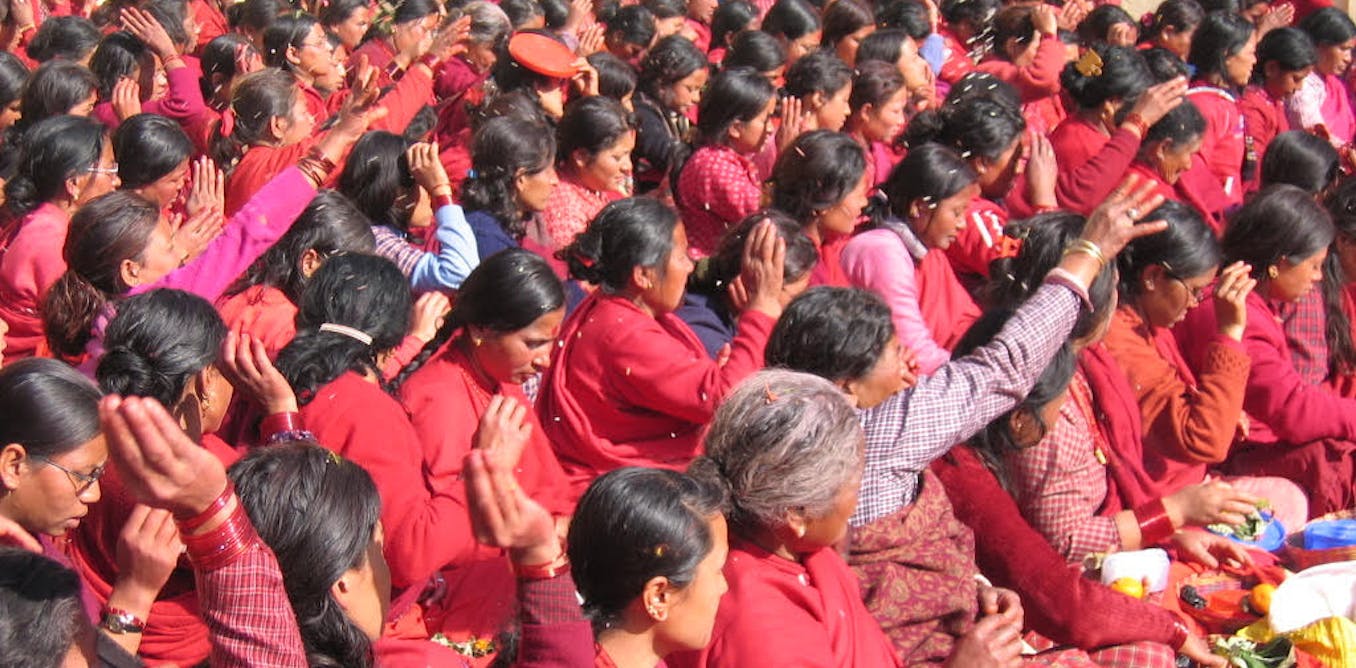

I first heard the popular “Swasthani Vrata Katha” – a devotional text – recited in Sankhu, a village on the outskirts of Nepal’s Kathmandu Valley, some 25 years ago.
The text tells the story, or “katha,” of the ritual vow, or “vrata,” that women devotees perform to earn the favor of Swasthani, a local Nepali Hindu goddess.
Every day during the cold lunar month of January-February, 100 to 200 Hindu women, dressed all in red, carry out a ritual that requires them to bathe in the local river, eat only one meal per day, remain singularly focused and worship the Hindu god Shiva at midday. In the evening, they recite the devotional text or listen to it being recited.
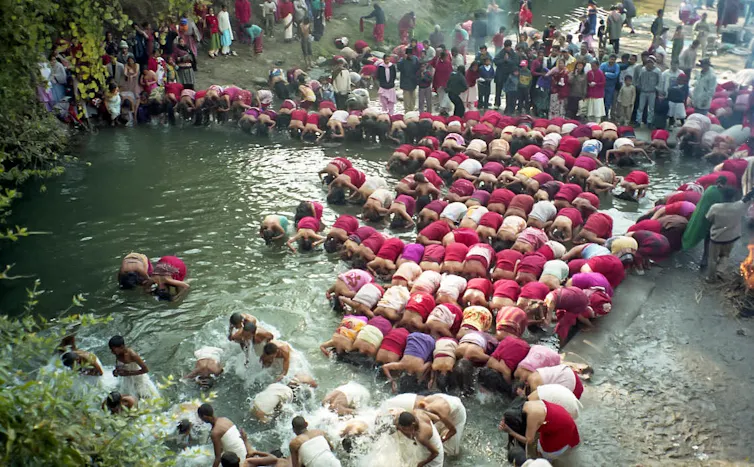
Women taking a ritual bath.
Jessica Vantine Birkenholtz, CC BY-SA
This practice dates to the 16th century and continues today. Nepali families gather daily at their home or at a relative’s home to recite one of the 31 chapters of the text. The recitation is done even if no one in the family is participating in the ritual vow. Most devotees observe only a two-day ritual vow at the end of the month’s recitation, but some women perform the ritual vow for the whole month.
At the end of the month, devotees prepare a series of offerings to Swasthani for the concluding ritual. These include ritually specific cooked foods, fruit and flowers. After the ritual offerings are blessed by Swasthani, devotees give a portion to their husband. If there is no husband, then to their son. If there is no son, then to the son of a friend.
I have joined many families in their homes during my archival and ethnographic work over the past two decades. Like many Nepalis, I listened patiently to the Swasthani’s stories while waiting eagerly for the sweet treats that were given at the end of the nightly recitation.
As a scholar of gender and Hinduism in Nepal, I am aware of two readings of the text in Nepal: Some see it reinforcing patriarchal expectations, while many women find strength through the enduring hardships and perseverance of its female characters.
Stories in the text
The Swasthani text has a prominent place in Nepali culture. It is the only locally written work of Hindu literature that is actively read by lay Nepali Hindus. It is their primary source for key Hindu myths.
The first two-thirds of the text explain the creation of the universe and recount the most widely known myths associated with the supreme god Shiva. These are stories familiar to most Hindus.
For Nepalis, it is the last third of the text that is especially meaningful. Here, the focus shifts to the local and relatable stories of three mortals – Goma, Navaraj and Chandravati – and their devotion to the local Nepali Hindu goddess Swasthani.
Goma is married as a 7-year-old to a decrepit 70-year-old man.