

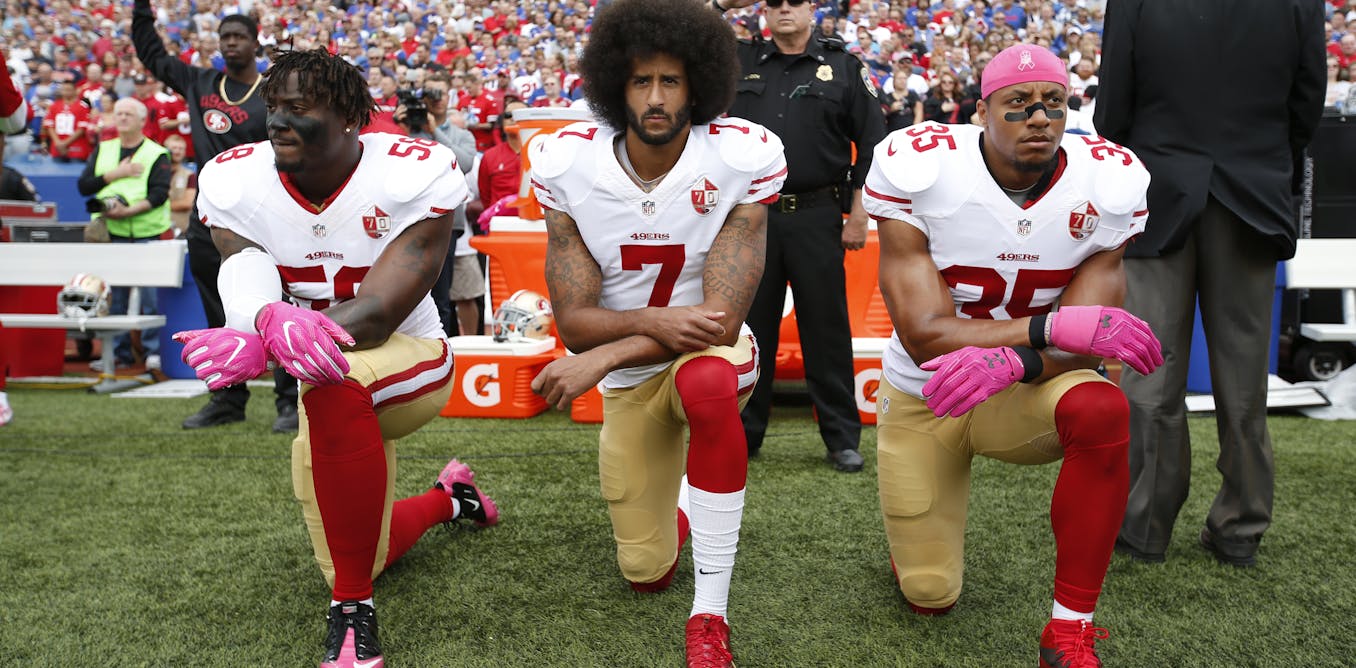

It’s almost a decade since San Francisco 49ers quarterback Colin Kaepernick started a worldwide trend and sparked fierce debate when he knelt during the US national anthem.
In 2016, Kaepernick refused to follow the pre-game protocol related to the national anthem and knelt instead, saying:
I am not going to stand up to show pride in a flag for a country that oppresses black people and people of colour.
Soon, many athletes and teams began “taking a knee” at sports events to express their solidarity with victims of racial injustice.
Now, they appear to have stopped, which prompted us to research the decline.
Initial widespread support
Following the intense public debate over the appropriateness of Kaepernick’s act, the ritual quickly spread worldwide, with athletes in major soccer leagues, cricket, rugby, Formula 1, top-tier tennis and the US’s Major League Baseball and National Basketball Association taking a knee.
Athletes didn’t always kneel during national anthems, with the majority kneeling at certain points pre-game.
Despite the occasional “defection” of a small number of players who would stand while their teammates knelt – such as Israel Folau in rugby league, Wilfried Zaha in soccer and Quinton de Kock in cricket – the ritual was widely embraced by teams and athletes and helped raise awareness of the issue.
Even major sports organisations notorious for prohibiting any type of political activism generally accepted the kneeling ritual. For example, soccer’s International Football Federation (FIFA) showcased kneeling as a “stand against discrimination” and as human rights advocacy.
The International Olympic Committee (IOC) initially stood firm by its Rule 50, which states “no kind of demonstration or political, religious, or racial propaganda is permitted in any Olympic sites, venues or other areas”.
But just three weeks before the 2021 Olympic and Paralympic Games in Tokyo, the IOC relaxed its interpretation, and athletes were permitted to express their views in ways that included taking a knee.
A surprising turn of events
Despite permission and even encouragement from sports governing bodies, our research shows the practice is disappearing from major sports competitions.
Take soccer, for example. At the FIFA World Cup 2022, England and Wales were the only national teams that knelt at their games in Qatar.
At the FIFA Women’s World Cup 2023 in Australia and New Zealand, no teams or players knelt.
The same happened at the 2024 Olympic soccer tournament in Paris.
That only a handful of teams knelt in Tokyo at the 2021 Olympics, two at the FIFA Mens’ World Cup in Qatar in 2022, none at the FIFA Womens’ World Cup in Australia and New Zealand in 2023, and again none at the Paris 2024 Olympics indicates a growing reluctance throughout the sports world.
This surely cannot mean athletes have become indifferent to racial injustice or other forms of oppression in the interval between the late 2010s and the mid-2020s.