


Skip to Main Content
Weather
A combination of above-normal temperatures and rainfall in the Northeast could also increase the threat of flooding.
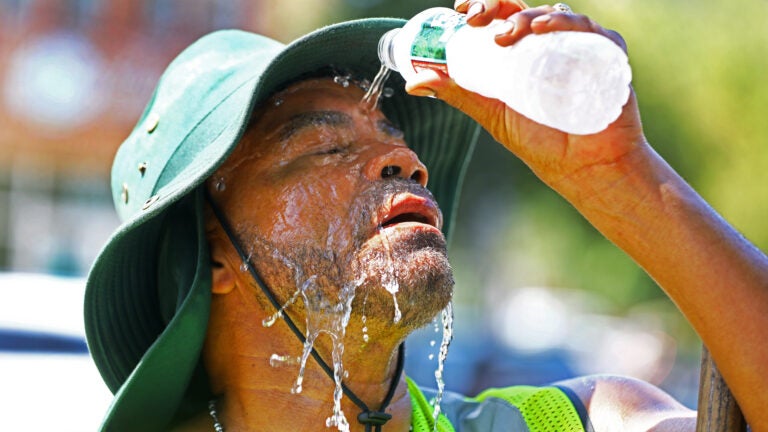
Paving crew worker Rafael Vasquez douses himself with water on Tremont Street in Boston during a 2021 heat wave. Hotter-than-normal conditions are favored almost everywhere in the U.S. this summer. Pat Greenhouse/Globe Staff
By Ian Livingston, Washington Post
April 22, 2024 | 1:20 PM
A new outlook for summer from the National Weather Service is a toasty one: Hotter-than-normal conditions are favored almost everywhere, except for a small portion of the northern Plains. The highest odds for a hot summer stretch from Texas into the Pacific Northwest, as well as much of the Northeast.
This forecast sets the stage for bouts of record-challenging high temperatures throughout the nation and the possibility of the hottest summer ever observed. In the central states and Rocky Mountains, the combination of heat and an expectation for drier-than-normal weather will increase drought potential. It will also raise the fire threat in some areas.
The hot forecast is linked to the probable switch from the El Niño to La Niña climate pattern by the summer’s second half.
While La Niña has a small cooling effect on the planet overall, it has boosted summer heat in the United States, especially in recent years when human-caused climate change has also fueled higher temperatures.
The three La Niña summers from 2020 to 2022 were all historically hot. The nation’s summer average temperature of 74 degrees in 2021 was tied for the hottest on record; 2022 and 2020 marked the third- and sixth-hottest summers, respectively.
“A common feature in summer during a developing La Niña is a semi-permanent upper-level ridge over the middle of North America,” wrote DTN, a forecasting company based in Minneapolis. “Ridges are notorious for hot and dry conditions.”
These ridges, referred to as heat domes, are common in summer but tend to be most persistent during La Niña.
Increased drought and wildfire risks
A hot summer often goes hand in hand with drought as high temperatures increase evaporation, which strips moisture from the land surface.
The driest weather compared to normal is expected to stretch from western Texas into the northern Rockies. The Weather Service predicts drought will persist or develop in much of this region.
Wetter-than-normal conditions are predicted in the Mid-Atlantic and Northeast, which are already off to a wet start this year. A combination of above-normal temperatures and rainfall in this zone could increase the threat of flooding.
The hot and dry conditions predicted in the Rockies would ordinarily support an elevated summer fire threat. However, large parts of this region are coming off a wet winter, so current outlooks show limited areas of higher-than-normal fire potential.
Still, pockets of the Southwest, Northwest and northern Rockies will see above-normal fire threats by June and July according to the Predictive Services of the National Interagency Fire Center.