


Active Citizens, Africa, Civil Society, Democracy, Editors’ Choice, Featured, Headlines, Human Rights, Inequality, Sustainable Development Goals, TerraViva United Nations
Democracy

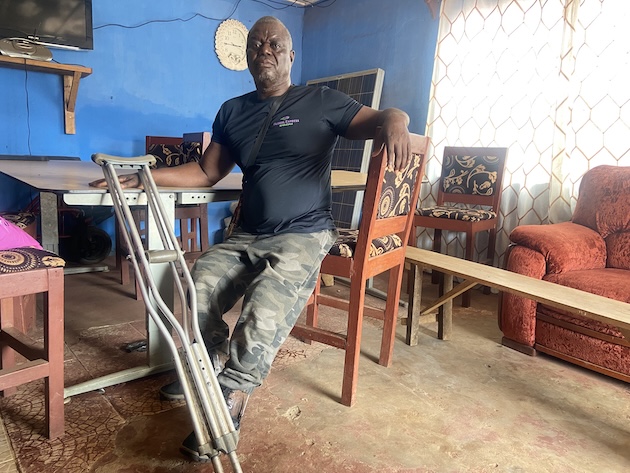
Samuel Alpha Sesay, Founder, All Political Party Disability Association. Credit: Madina Kula Sheriff/IPS
FREETOWN, Apr 10 2026 (IPS) – As Sierra Leone prepares for its next national election in 2028, political parties across the country have begun setting strategies and preparing to select their candidates. However, persons with disabilities say they remain poorly represented and are calling on political parties to nominate them as candidates ahead of the election.
Samuel Alpha Sesay, a person with a physical disability living in Freetown, the capital of Sierra Leone, is among those advocating for change. He still recalls the last general election, held in 2023, and how there was no person with a disability vying for any position in government.
In 2025, he founded the All Political Party Disability Association to challenge the long-standing exclusion of persons with disabilities from governance. Sesay says the lack of representation of persons with disabilities in national elections pushed him to establish the group.
According to Sierra Leone’s 2015 Population and Housing Census, about 93,129 people in the country have a disability, representing approximately 1.3% of the total population. The 2018 Integrated Household Survey reported a higher figure of 310,973 persons with disabilities, accounting for 4.3% of the population.
“For decades, persons with disabilities have actively participated in elections as voters, rarely as candidates, despite forming a significant part of Sierra Leone’s population,” says Sesay, who believes that participation in political parties’ activities alone is no longer enough.
“We do not want to remain in the party wings. We want persons with disabilities to be part of the core leadership of political parties,” he adds.
Breaking Deep-Rooted Perceptions
Sesay and others argue that stigmatisation and deep-rooted societal perceptions are among the barriers affecting their participation in politics.
Sylvanus Bundu, a man with a physical disability in his fifties, agrees with Sesay. He told IPS that one of the most persistent barriers to political inclusion is the perception that persons with disabilities are incapable of effective leadership.
“People feel sorry for us, but we do not want sympathy. Disability does not mean inability. We want society to unlearn these perceptions and allow us to lead,” says Bundu.
He adds that such perceptions are deeply embedded in social and political institutions and often translate into exclusion from candidate selection processes and leadership appointments.
Sesay says similar perceptions once shaped attitudes toward women before the introduction of the 30 percent quota ahead of the 2023 general elections. He argues that such views were used to justify excluding women from leadership positions.
However, he notes that the introduction of the Gender Equality and Women’s Empowerment (GEWE) Act 2022, which mandates a 30 percent quota for women’s political representation, marked a turning point.