


Africa, Biodiversity, Conservation, Environment, Featured, Global, Headlines, Ocean Health, Sustainable Development Goals, TerraViva United Nations
Conservation

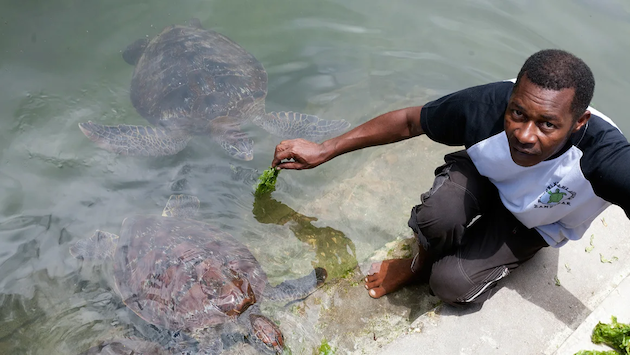
Ali Hamadi, a turtle conservationist, feeds a turtle swimming in a lagoon in Zanzibar. Credit: David Duni/IPS
ZANZIBAR, Tanzania, Nov 25 2025 (IPS) – On a warm morning at Matemwe, a small crowd gathers behind a rope barrier as the sand begins to tremble. A tiny head pushes through a soft mound of earth, then another, and another. Within minutes, the shallow nest—protected for weeks by a ring of wooden stakes and mesh—comes alive with the rustle of dozens of hatchlings. Volunteers crouch nearby, recording the emergence time and shading the small creatures with their hands to protect them from swooping gulls.
There is no fanfare as the newborn turtles scurry instinctively toward the shoreline, guided by the rising sun. For volunteers who have monitored the hatchery for weeks, it is a moment of triumph. The turtles are released immediately—scientists say their survival chances increase when they reach the ocean quickly, sharpening their orientation for waters increasingly threatened by plastic pollution, overfishing, and warming currents.
This is the rhythm during breeding season at the Marine Turtle Hatchery in Matemwe, a village on Zanzibar’s northeastern coast where efforts to save one of the world’s most ancient marine species happen along white-sand beaches.
A Frontline for Life Below Water
Zanzibar’s coastline attracts tourists to its blue waters and coral reefs. But the ecosystem beneath is strained by pollution, habitat loss, and unregulated fishing. Matemwe, long known for its pristine beaches, is now emerging as an unexpected frontline in marine conservation.
Central to this work is a community-driven project supported by International Volunteer HQ (IVHQ), where volunteers work with local marine biologists to protect endangered sea turtles and bolster marine life.
“These hatcheries are vital to saving turtles and restoring the ecosystem. Every hatchling we protect supports reefs, fisheries and the livelihoods of communities that depend on the ocean,” says Ali Hamadi, a marine conservation officer in Zanzibar.
“Every nest we protect secures years of future life in the ocean, from turtles to the fish that rely on healthy reefs,” he says
Rescuing a Species
Most of Matemwe’s turtle nests are on beaches threatened by pollution and high tides. Volunteers routinely monitor nesting grounds, relocate threatened nests to safer areas within the hatchery, and patrol the shorelines for signs of digging.
“It’s delicate work,” explains Hamadi. “We move the eggs only when absolutely necessary. We must keep their environment natural.”
Volunteers routinely remove plastic bags, fishing nets, and discarded bottles that often suffocate turtles or trap hatchlings before they can reach the sea.
A Battle Against Pollution
Marine biologists say the biggest threat to turtles in Matemwe is pollution due to the island’s growing plastic waste management crisis. Plastics often wash up on the shores where turtles lay their eggs,