

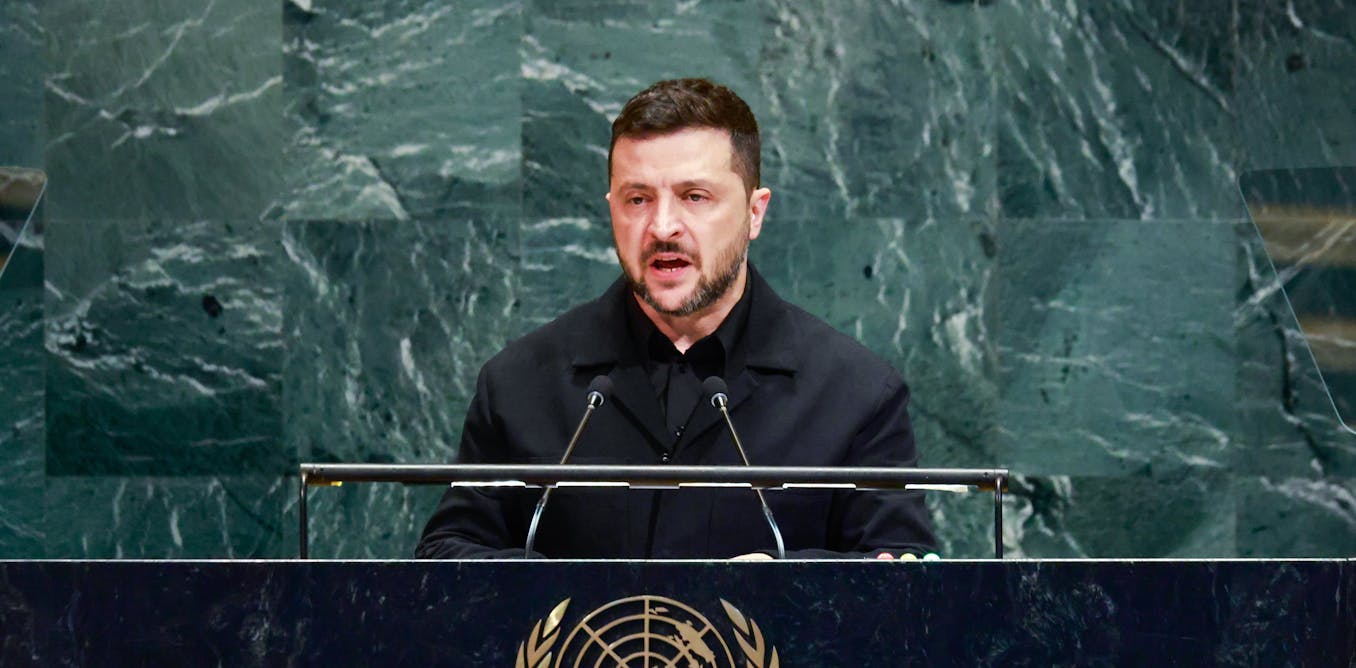

In a speech at the UN headquarters in New York, where world leaders are currently gathered for the organisation’s 80th anniversary, Ukrainian president Volodymyr Zelensky warned: “We are now living through the most destructive arms race in human history.”
The proliferation of drone technology combined with the rapid development of AI, Zelensky remarked, could create “dead zones” in the near future. He defined these as areas “stretching for dozens of kilometres where nothing moves, no vehicles, no life. People used to imagine that [scenario] only after a nuclear strike – now it’s [a] drone reality.”
AI could soon enable “swarms” of drones that operate autonomously together in a coordinated manner. So far this has only been seen in sci-fi movies but we are now starting to see the beginnings of this technology in real life, including from the Ukrainian military.
For security scholars such as Audrey Kurth Cronin of Carnegie Mellon University in the US, we are now in a time of “open tech innovation”. This is a period where people – whether terrorists or criminal groups – do not need the expertise and resources of a state to be able to orchestrate nefarious acts of disruption and destruction.
Zelensky and Kurth Cronin believe this new age of military technology requires new rules and enhanced global collaboration if the worst-case scenarios are to be avoided. “We need to restore international cooperation – real, working cooperation – for peace and for security,” said Zelensky in his UN speech. “A few years from now might already be too late.”
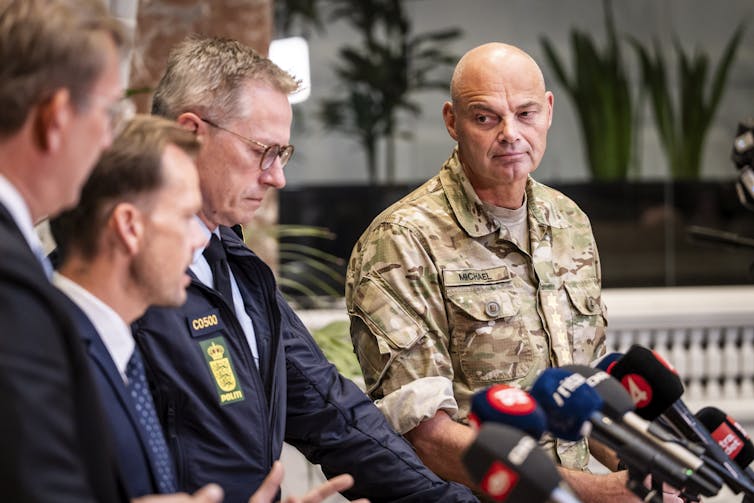
Danish government ministers providing an update on the recent drone activities at several airports across Denmark.
Emil Helms / EPA
Days before these remarks, drone activity caused multiple airports in Denmark to close. The country’s defence minister, Troels Lund Poulsen, told a news conference that the “attack” was part of a “systematic operation”. Some reports have suggested that Russia may have been behind these acts.
One of the major concerns among security experts worldwide in recent years has been on acts of sabotage that play out below the threshold that can lead to open war. In what is known as “hybrid warfare”, states and criminal groups can orchestrate a variety of tactics to generate fear and cause disruption.
These acts may be intended for political ends – for instance, by creating discontent with political leaders. They may also be intended to test the systems of security that are important for defending against military action. The incursion of Russian drones into Polish airspace in early September, for example, generated serious debate about how Nato should respond.
These recent events may signal that the world is now in a new age of military-technological insecurity that, as Zelensky warned the UN, is only going to get worse in the years ahead.
Read more:
Russian drones over Poland is a serious escalation – here’s why the west’s response won’t worry Putin
Deterring futuristic war
Central to defence policy and strategic thinking is deterrence.