

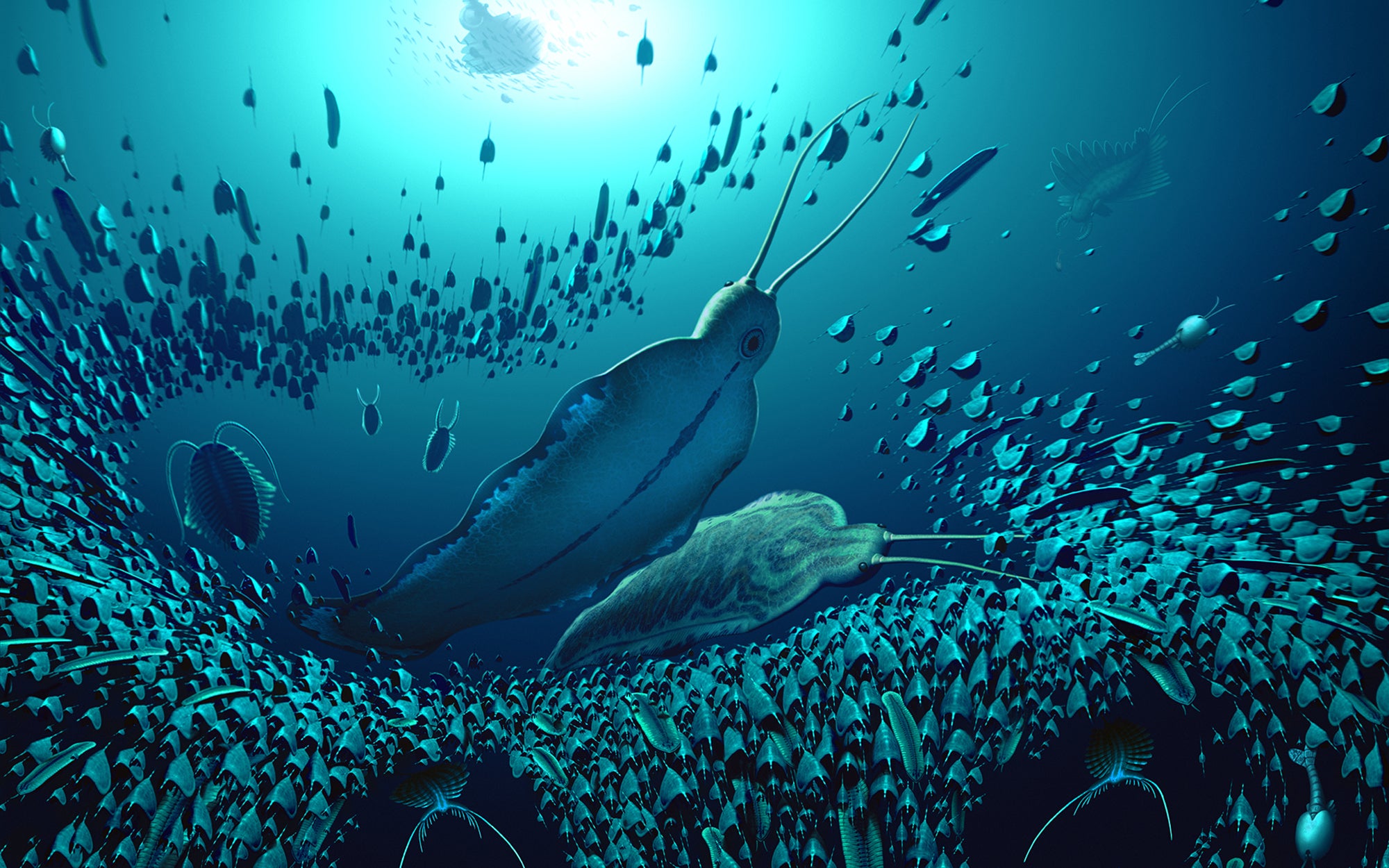

The ancient creature named Timorebestia, or ‘terror beasts’ in Latin, lived in the water column of North Greenland over 518 million years ago. The new fossils indicate that the worms had fins on the sides of their bodies, a head with a long antenna, and enormous jaw structures on the insides of their mouth. They could grow to almost 12 inches long. These were some of the largest swimming animals of the Early Cambrian period and are described in a study published January 3 in the journal Science Advances.
[Related: A three-eyed organism roamed the seas half a billion years ago.]
An ‘explosion’ of life
When these terror beasts were alive over 500 million years ago, the Earth was undergoing a major expansion of life called the Cambrian Explosion. This is when most major groups of animals first appear in the fossil record, partially due to cooler temperatures and tectonic changes. All of this biological diversification also occurred in a relatively short period of time–in about 30 million years.
The Timorebestia fossils were found during a 2017 expedition to the Early Cambrian Sirius Passet fossil locality in a very remote section of North Greenland. Timorebestia may be some of the earliest carnivorous animals to have colonized the water column here and reveal a past potential dynasty of predators that were previously unknown to scientists. Early arthropods were known to be the dominant predators during the Cambrian period, including some “weird shrimp from Canada” called anomalocaridids.
“Our research shows that these ancient ocean ecosystems were fairly complex with a food chain that allowed for several tiers of predators,” study co-author and University of Bristol paleontologist Jakob Vinther said in a statement. “Timorebestia were giants of their day and would have been close to the top of the food chain. That makes it equivalent in importance to some of the top carnivores in modern oceans, such as sharks and seals back in the Cambrian period.”
Timorebestia is also a distant but close relative of living arrow worms called chaetognaths. These worms are much smaller than today’s enormous ocean predators and only eat zooplankton, a far cry from their apex predator days of the past.
Opening a 518 million-year old digestive system
The fossils from the Sirius Passet were exceptionally well preserved so the team was able to study the remains of their muscle anatomy, nervous systems, and digestive systems very closely. When they looked inside Timorebestia’s fossilized digestive system, they found the remains of a common, swimming arthropod called Isoxys.