

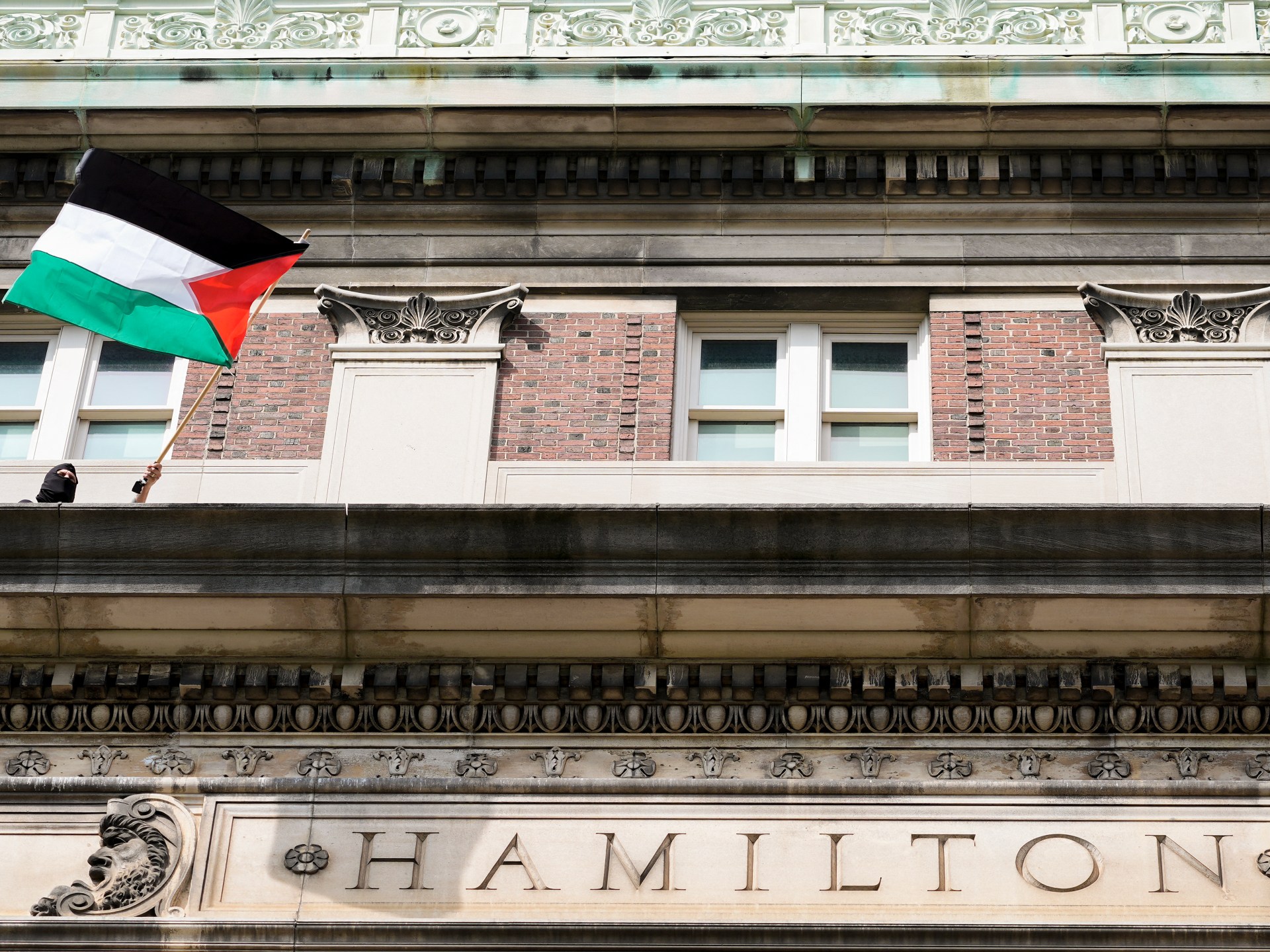

Hamilton Hall, the academic building at Columbia University that students protesting against Israel’s war on Gaza occupied early on April 30, has a long history of student protests.
Over the past half-century, students have barricaded themselves there in protest at pivotal moments in history, including the Vietnam War and the growing global momentum against apartheid in South Africa.
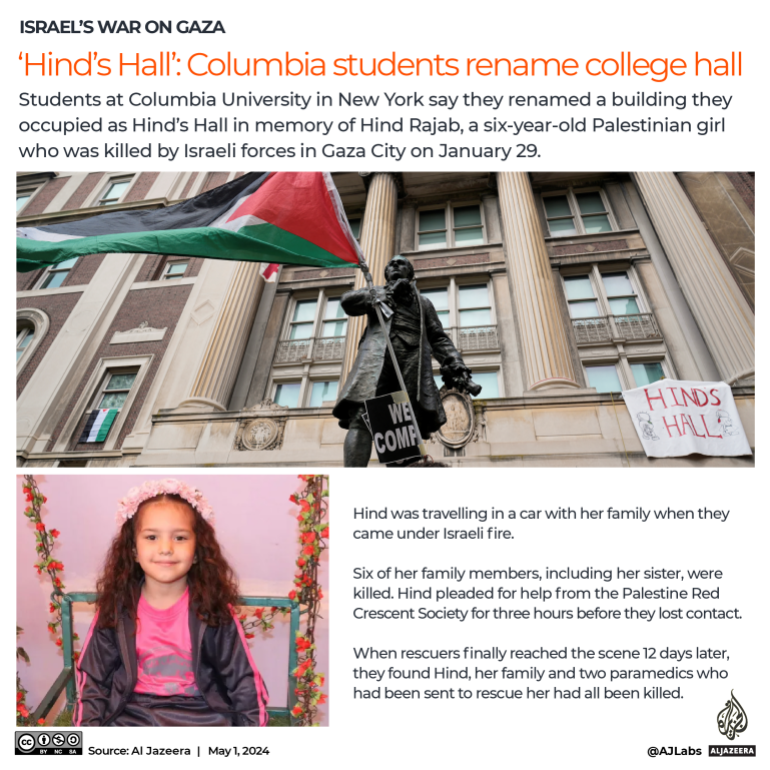
Protesters dubbed the building “Mandela Hall” in honour of the South African liberation leader during the 1985 student blockade. Echoing the 1985 protests, students who took over the building on Tuesday renamed it “Hind’s Hall” in honour of six-year-old Hind Rajab, who was killed alongside her family by Israeli forces in Gaza.
On Wednesday morning, police officers entered the campus, taking dozens of people into custody in the latest escalation between student-led, pro-Palestinian protests and law enforcement authorities.
That crackdown too, like the takeover of Hamilton Hall by students, is in keeping with the history of the building as an iconic protest venue at Columbia.
What is Hamilton Hall?
The hall was inaugurated in 1907 as a flagship building and still houses the dean’s office.
“This is a great day for the college,” Dean John Howard Van Amringe said at the time. “Our alma mater has a home of her own — a building more stately and beautiful, as of right it ought to be, more gracious and significant than any other on the grounds of the university.”
An outdoor sculpture of Alexander Hamilton, who became the first treasury secretary of the United States in 1789 and the founder of the US banking system, stands proudly at the entrance. Hamilton is generally depicted as an abolitionist. However, some research suggests his antislavery credentials may have been inflated.
Alongside four department offices — Germanic Languages, Slavic Languages, Classics, and Italian Languages — it houses the Center for Race and Ethnicity.
A renovation that began in 2000 brought about a new Center for the Core Curriculum, home to the Literature Humanities, Contemporary Civilisation, Music Humanities, Art Humanities and Major Cultures departments.
When have Columbia students occupied Hamilton Hall before?
1968: Vietnam protests
In April 1968, Hamilton Hall was the first of five buildings to be taken over by students protesting against the Vietnam War.
Demonstrators barricaded themselves and prevented acting dean Henry Coleman from leaving his office for one night.
By April 30, a week after the protest started, police officers cracked down on the protesters, entering the building through underground tunnels and forcefully clearing the students.
More than 700 people were arrested, one of the largest mass detentions in New York City history. At least 148 people were injured as some were hit with nightsticks and dragged out, according to the student newspaper.
The protests resulted in the university cutting ties with a Pentagon institute doing research for the Vietnam War and led to reforms favouring student activism.