


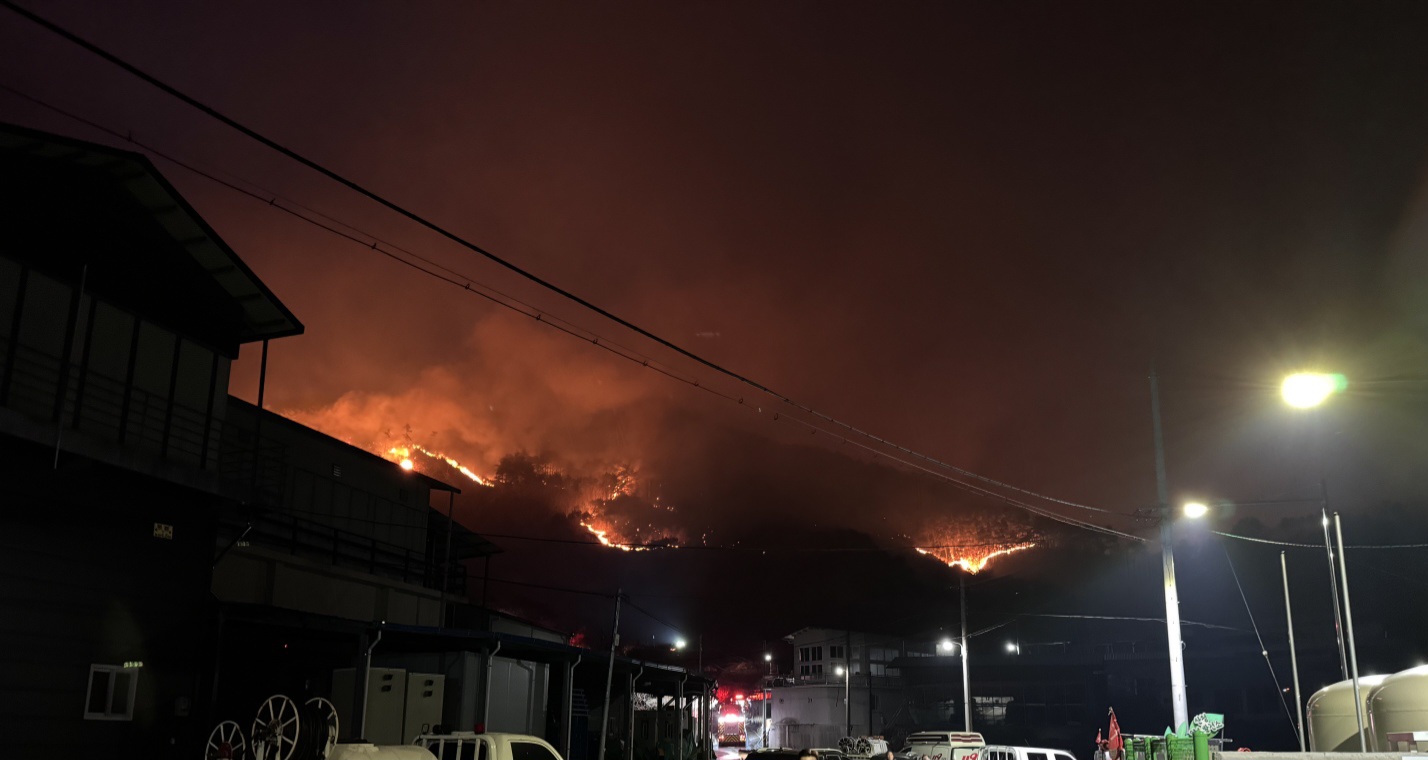
 Forest fire in Sancheong, Gyeongsangnam-do. Image by Gyeongnam Regional Government.
In March 2025, southeastern Korea experienced its largest and most destructive wildfires on record.
More than a dozen fires broke out on March 22nd and 23rd and spread rapidly over the following days. More than 48,000 hectares burned – over 20,000 hectares more than the second most devastating wildfires, in April 2022, and more than ten times the annual average burnt area.
With 32 casualties, the fires are also South Korea’s deadliest wildfires on record, additionally injuring 45 people, and displacing about 37,000 residents (AFP, 2025). Most victims were in their 60s and 70s. Uiseong was hardest hit, with 26 deaths, while four occurred in Sancheong. Around 5,000 buildings, including homes, factories, and farms, were destroyed (McGrath, 2025).
Rural and suburban areas, especially those where homes border forests (WUI zones), were hit hardest. Uiseong also lost the historic Gounsa Temple, built in 618 AD, and 30 other cultural heritage sites, including Joseon-era relics (Sang-Soo, 2025).
While March to April is the season commonly experiencing wildfires, this year was marked by exceptionally low rainfall in the months preceding the fires and very high temperatures, more than 10C above average, on the days of the outbreak. To analyse whether and to what extent human-induced climate change exacerbated these conditions and what role vulnerability and exposure played in the historic event, researchers from South Korea, the Netherlands, Sweden, Denmark, Mexico, the United States and the United Kingdom undertook an attribution study on the fire weather conditions as well as the preceding dryness.
To capture the event, the team looked at the 5-day maximum Hot-Dry-Windy Index (HDWI) in March, over all of South Korea (see figure 1). The HDWI multiplies the maximum wind speed with the maximum vapour pressure deficit – which combines temperature and humidity to define the drying power of the atmosphere – which reflects high fire risk. In addition rainfall between February and March over the same region was also analysed.
 Figure 1: Map of HDWI based on era5 land data, showing very high indices between the 22nd and 26th of March
 Figure 2: 5-day HDWI averaged over South Korea from 1990 to 2024 (orange) and 2025 in black. The 5 days of the fires are highlighted in yellow.
Main Findings
- The fires particularly impacted areas where forests border residential, industrial, and heritage sites, which are crucial for risk reduction and land-use planning. Many of the affected people were older adults or individuals with limited mobility, especially in rural and peri-urban areas, making evacuation difficult.
- Even in today’s climate, that has warmed by 1.3°C due primarily to the burning of fossil fuels, the combination of high temperatures, low humidity and high wind speeds (HDWI) observed over the 5 days following March 22nd, when the fires broke out, was very unusual. In the current climate they are expected on average about once every 300 years.