


Enhancing Lunar Robot Operations with Realistic Computer Model
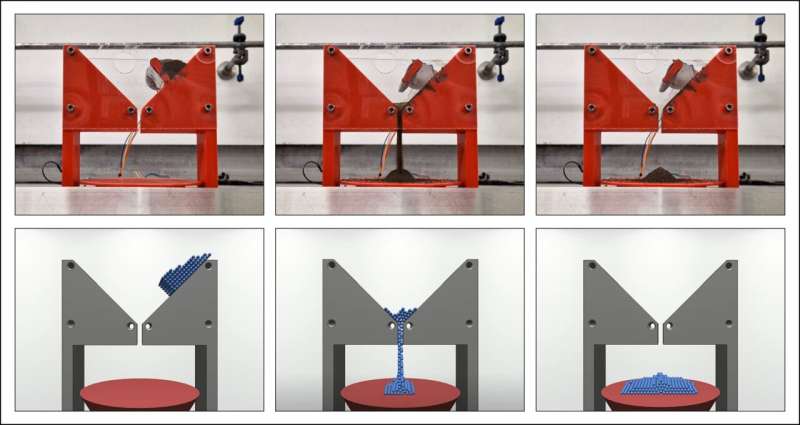
A cutting-edge computer model that emulates moon dust with incredible accuracy could revolutionize lunar robot teleoperations, leading to more seamless and secure missions. Developed by experts at the University of Bristol and housed at the Bristol Robotics Laboratory, this innovative tool has the potential to train astronauts for upcoming lunar expeditions.
This groundbreaking research has been detailed in the prestigious journal Frontiers in Space Technologies.
In collaboration with Thales Alenia Space in the UK, a key player in the development of functional robotic systems for space applications, the research team delved into a virtual representation of regolith, the scientific term for moon dust.
The manipulation of lunar regolith is crucial for the upcoming lunar exploration endeavors slated for the next decade. This material holds the promise of extracting valuable resources like oxygen, rocket fuel, or construction materials essential for sustaining a long-term presence on the moon.
Considering the vast distances involved, remotely controlled robots emerge as a pragmatic choice for regolith collection, given the reduced risks and costs associated with human spaceflight. Nonetheless, managing these robots over such expansive distances introduces significant delays into the system, rendering control more challenging.
By validating that the simulation closely mirrors reality, the team can leverage this tool to simulate the operation of a robot on the moon. This methodology enables operators to control the robot without the delays typically encountered, facilitating a smoother and more efficient experience.
Joe Louca, the lead author affiliated with Bristol’s School of Engineering Mathematics and Technology, elucidated, “Imagine it as a true-to-life video game scenario unfolding on the moon—we aim to ensure that the virtual rendition of moon dust behaves just like the real counterpart, enabling seamless control of a robot on the lunar surface. This precise, scalable, and lightweight model holds tremendous potential in supporting forthcoming lunar exploration missions.”
Building on their previous findings, the team uncovered that seasoned robot operators prefer a training regimen encompassing progressive risk escalation and realism. This entails commencing with simulations, transitioning to physical mock-ups, before eventually graduating to utilizing the actual system. A precise simulation model plays an instrumental role in training operators and fostering their trust in the system’s functionality.
While earlier iterations of moon dust models existed, their intricate details demanded extensive computational resources, rendering them unfit for smooth robot control. Researchers from the German Aerospace Centre (DLR) addressed this challenge by crafting a virtual regolith model that accounts for its density.
For more information, you can access the full article here.
To delve deeper into this fascinating study, feel free to click ‘Read More’ here.