

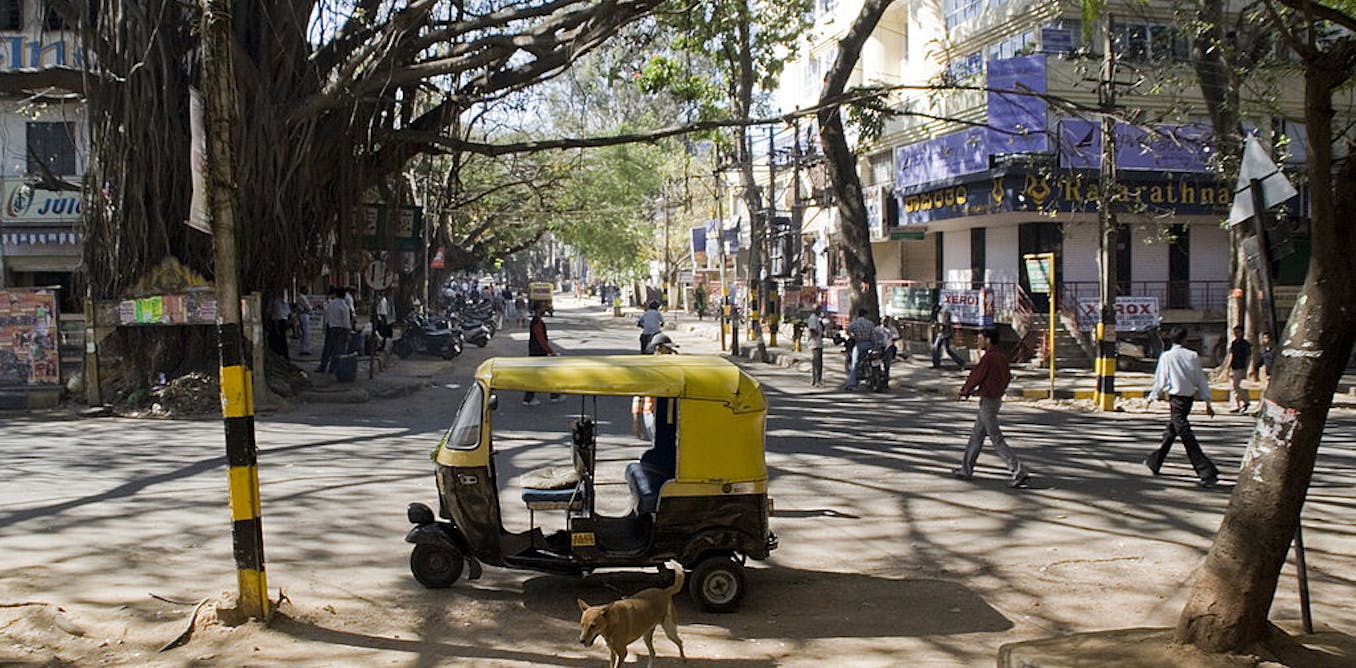

We usually think of nature and cities as complete opposites. However, my research on Bangalore, or Bengaluru – India’s IT hub – shows that this is far from true. As I delve into the ecological history of this Indian city in my book Nature in the City: Bengaluru in the Past, Present and Future, I trace its centuries-long, strong relationship with nature, going all the way back to the 6th century CE.
Ancient inscriptions on stone and copper plates reveal that the starting point for a new village in Bangalore was often the creation of a tank, or lake, to collect rain water – essential and life-giving in that low-rainfall environment. These inscriptions provide fascinating insights into the close relationship that the early residents had with nature, viewing the landscape as consisting of the lakes, the surrounding irrigated and dry land, the “wells above”, and the “trees below”. This three-dimensional perspective of the landscape, consisting of two major resources, water (lake) and food (agriculture), nourished by nature below (in the form of wells) and above (in the form of trees) is a remarkably holistic conception of nature.
Unfortunately, we have lost all trace of this three-dimensional vision in today’s urbanized India.
The central areas of Bangalore had 1960 open wells in 1885; today, there are fewer than 50. Bangalore also lost many of its lakes, which were considered to be filthy breeding grounds for malaria, and converted to bus stands, malls, housing, and other built spaces.
The city’s central Sampangi lake, which supplied water to many parts of Bangalore in the 19th century, was transformed into a sports stadium by the 20th century, leaving behind only a tiny pond for ceremonial religious purposes. As long as lakes and wells supplied water, essential for the activities of daily life, they were worshipped as sacred and protected as life-giving.
Rituals celebrating the overflowing of lakes during the monsoon by paying homage to the lake goddess kept the importance of lakes in the forefront of people’s imaginations. But once piped water began to be provided in the 1890s, these water bodies began to decay. By the end of the 19th century, wells and lakes began to be polluted with garbage, sewage, and even corpses during times of epidemics and disease.
What transformed this centuries-long, strong relationship between people and nature? When Bangalore shattered its local loop of dependence by importing water from outside,