


Understanding the Adaptive Nature of Immune Cells
Have you ever wondered how your immune system prioritizes between fighting off invading pathogens immediately or preparing to combat them in the future? Interestingly, research shows that the immune system has the capability to alter its decision-making process.
The Role of T Cells in Immune Response
Each individual possesses between 10 million to 100 million unique T cells that play a crucial role in the immune system by constantly scanning the body for foreign invaders and cancerous cells to eliminate. These T cells are equipped with distinct receptors that enable them to identify foreign proteins on infected or cancerous cells. When a T cell encounters the specific protein it recognizes, it undergoes rapid replication to generate a larger number of cells to eradicate the invading pathogen.
This proliferation process results in the formation of both short-lived effector T cells, responsible for immediate pathogen elimination, and long-lived memory T cells, essential for providing immunity against future infections. But the question arises: how do T cells determine whether to prioritize the immediate eradication of pathogens or prepare for potential future threats?
Insights from Bioengineering Research
A team of bioengineers, including researchers like Kathleen Abadie and Elisa Clark, have been investigating the maturation process of immune cells. Their recent publication in the journal Immunity sheds light on the discovery that having multiple decision-making pathways for immune cells results in enhanced responsiveness to various challenges.
Their research, emphasizing the adaptability of immune cells in deciding the course of action against pathogens, highlights the dynamic nature of the immune system’s response mechanisms.
T Cell Decision Making: Balancing between Fighting and Remembering
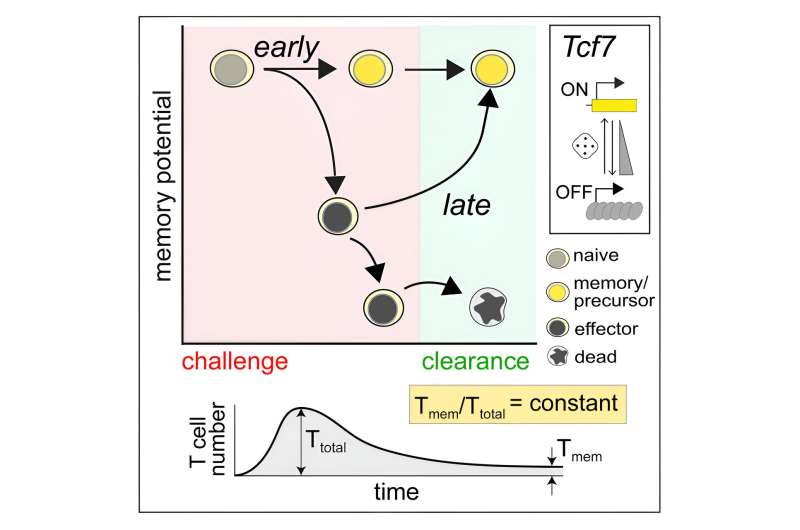
Observing T cells dividing in response to a simulated pathogen encounter has shed light on the crucial decision-making process of these cells. When faced with pathogens, T cells must choose between becoming effector cells that fight the immediate infection or memory cells that prepare for future encounters.
Our study focused on tracking the activity of a gene known as T cell factor 1 (TCF1), which is vital for the longevity of memory cells. Interestingly, we discovered that the stochastic silencing of the TCF1 gene during pathogen encounters drives an initial fork in the road for T cells, determining whether they develop into effector or memory cells. Higher pathogen levels increase the likelihood of T cells becoming effector cells.
Surprisingly, some effector cells that initially switched off TCF1 were able to reactivate it after clearing the pathogen, transitioning into memory cells. This adaptive capability highlights the dynamic nature of T cell decision-making.
Through mathematical modeling, we identified that the flexibility in decision-making processes among memory T cells is crucial for generating the appropriate balance of immediate responders and future preparers based on infection severity.
Immune Memory and Disease Resistance
The establishment of robust, long-lasting T cell memory is essential for effectively combating a wide range of diseases, from the flu to COVID-19 to cancer.
Examining immune memory formation from not only a biological but also a social and cognitive science perspective provides valuable insights into the intricate workings of our immune system. This multidisciplinary approach enhances our understanding of how T cells navigate the complex landscape of infection responses.