

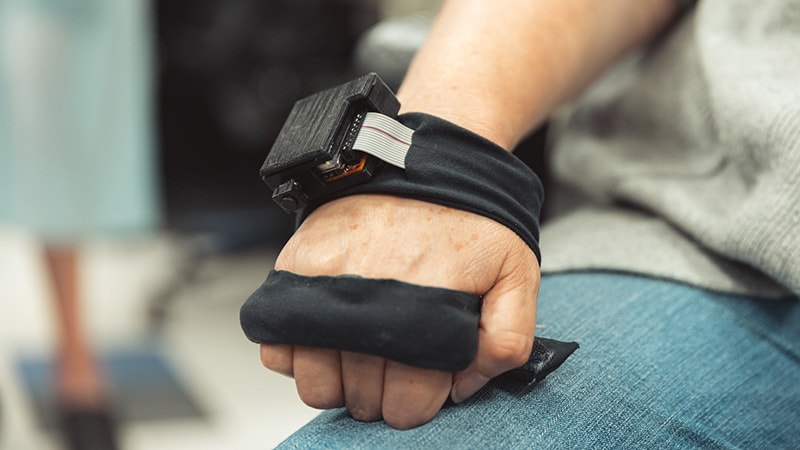

Innovative Wearable Device for Treating Chronic Stroke
A revolutionary approach to chronic stroke treatment may come in the form of a vibrating glove, a simple yet groundbreaking invention. Researchers at Stanford University and Georgia Tech have collaborated to create a wearable device that attaches to the wrist and hand, emitting gentle vibrations similar to those of a vibrating cellphone. These vibrations have shown promise in alleviating spasticity, potentially offering a more effective alternative to traditional Botox injections.
According to Dr. Allison Okamura, a senior study author and mechanical engineer at Stanford University, the vibro-tactile stimulation provided by the glove can be conveniently used at home and may be a cost-effective solution for patients. While currently only accessible to clinical trial participants, the researchers aim to make the device more widely available in the coming years. With the support of a recent grant from the National Science Foundation’s Convergence Accelerator program, they are working towards commercializing the glove and expanding its reach through larger clinical trials.
This novel approach builds upon existing research on the benefits of vibration and other forms of stimulation in treating neurological conditions. Vibrating gloves have previously helped reduce involuntary movements in patients with Parkinson’s disease, while the University of Kansas Medical Center is set to test a FDA-approved vagal nerve stimulator to aid in motor function recovery for stroke survivors. Different vibration patterns and intensities are tailored to target specific disease states accordingly.
Vibro-Tactile Stimulation for Post-Stroke Rehabilitation
Spasticity, a common complication that may arise or worsen months after a stroke, often presents challenges for patients who have exhausted their insurance coverage for rehabilitation. Moreover, the efficacy of Botox injections, a standard treatment for spasticity, may diminish over time. In a clinical trial, participants wore the vibrating glove for 3 hours daily over 8 weeks, with symptom relief persisting or improving even after discontinuation. More than half of the patients reported equal or superior outcomes compared to those receiving routine Botox injections.
Unpacking the Mechanism of Action
The concept of vibro-tactile stimulation (VTS) as a therapeutic tool emerged at Georgia Tech, where Dr. Caitlyn Seim, a postdoctoral research fellow working with Dr. Okamura, utilized VTS for touch-feedback training, such as piano playing skills. By targeting spasticity, the researchers tapped into the potential of VTS demonstrated in prior non-wearable devices. Through neuroplasticity, the device aids in creating new synaptic connections or reinforcing existing ones in the brain by enhancing sensory signals to facilitate neural circuit reconnection.
In conclusion, this vibrating glove represents a promising advancement in chronic stroke rehabilitation, offering a non-invasive and potentially more sustainable treatment option for patients experiencing spasticity. As research continues to validate its efficacy and safety, the future looks bright for integrating innovative wearable technology into stroke recovery protocols.