


World
/
December 12, 2023
Uganda’s role as a co-convenor of the Global Refugee Forum in Geneva this week should raise urgent questions about the interests behind its much-lauded open-door refugee policy.
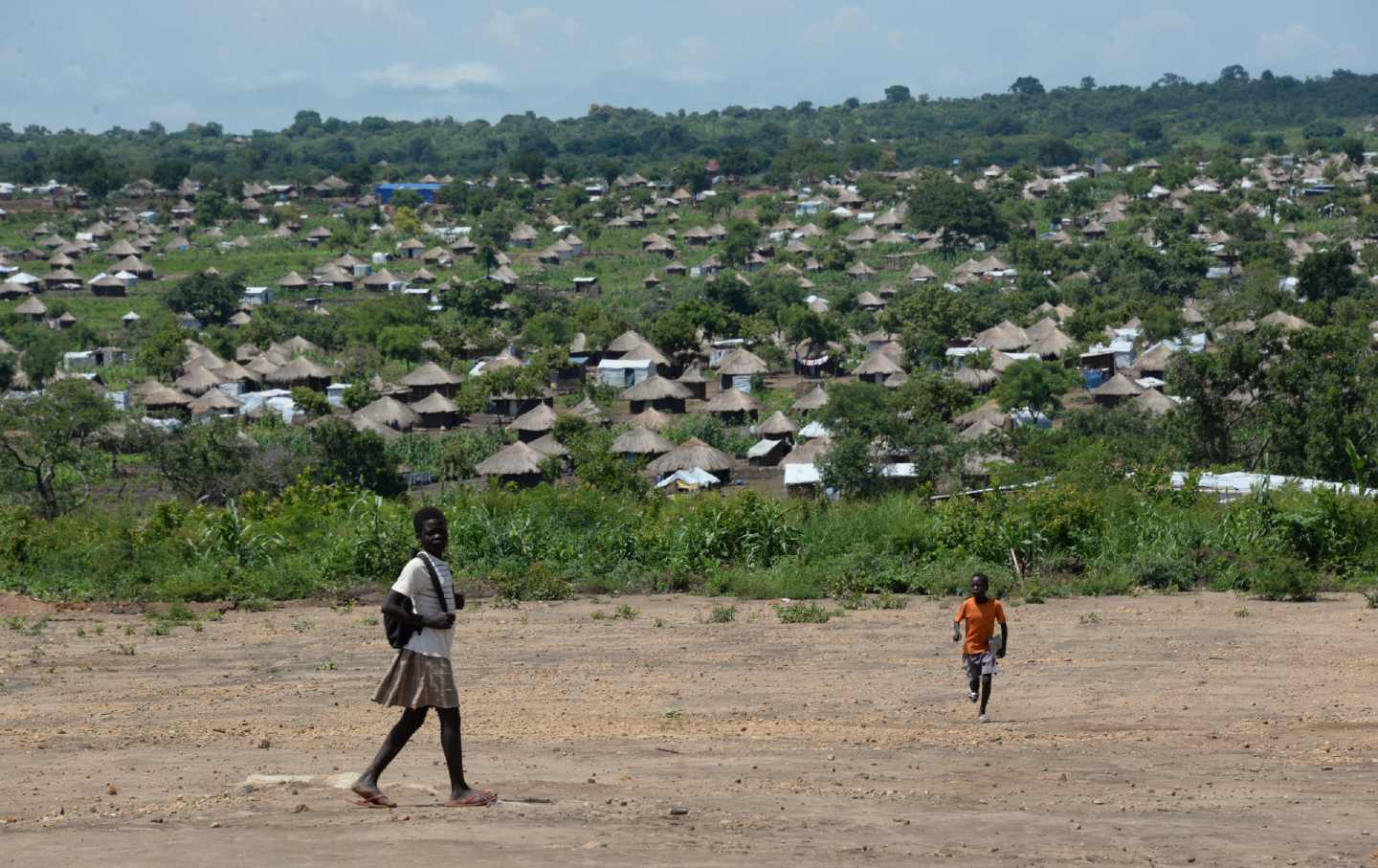 Children walk along a road in the Bidi Bidi refugee settlement in northwestern Uganda. (Gioia Forster / Picture Alliance via Getty)
Kampala—“I’m barely surviving in Uganda, but I am still alive,” says a refugee from the Democratic Republic of Congo whom I’ll call Joseph, as goats and chickens scuttle through Kampala’s informal settlements. Over several weeks, refugees from the DRC, Somalia, South Sudan, Burundi, Rwanda, Eritrea, and Afghanistan, among other countries, each told The Nation their stories of displacement to Uganda, a co-convenor of the United Nations’ upcoming 2023 Global Refugee Forum. Most ended on a similar note: We are struggling, even starving, but we are safe.
At the Geneva forum beginning December 15, this East African country and temporary home to 2.4 million refugees will be showcasing what is known as the “Uganda Model” for refugee-hosting based on its 2006 Refugee Act—hailed time and again by the United Nations and Western media as the most progressive in the world. And yet, while humanitarian and refugees groups recognize that Uganda’s approach is indeed progressive, the refugees’ increasingly dire circumstances amid aid cuts and failed strategies should be raising urgent questions about why the West is so invested in holding up Uganda as a model to the rest of the world. So, too, should President Yoweri Museveni’s growing authoritarianism. Could it be, as some critics have suggested, that the West is willing to overlook both poor conditions in settlements and Museveni’s dangerous power grabs in order to prevent refugees from reaching our own shores?
Based on the United Nations’ 1951 Refugee Convention and its 1967 protocol, Uganda’s refugee approach does stand out internationally for its “open-door” approach and the codification of refugees’ right to work, freedom of movement, and free access to public services. Its Comprehensive Refugee Response Framework (CRRF), established in 2018 based on the New York Declaration for Refugees and Migrants, is also held up as an example thanks to its coordinating committee, which includes both refugees and local representatives.
Uganda’s refugee status adjudication process is also far more straightforward than most—and has been expedited for those fleeing neighboring South Sudan or Democratic Republic of Congo thanks to prima facie designation that recognizes the ongoing conflicts in both countries as the source of displacement. As for its “open door” approach, Ugandans say this is grounded in a Pan-Africanism that even their president for the past 37 years espouses. Like many of his fellow Ugandans, Museveni himself was displaced during Idi Amin’s rule, an experience that, to many in East Africa, drove home the fact that anyone can become a refugee.
“Sometimes the West lacks a humane approach,” says Refugee Commissioner Douglas Asiimwe,