

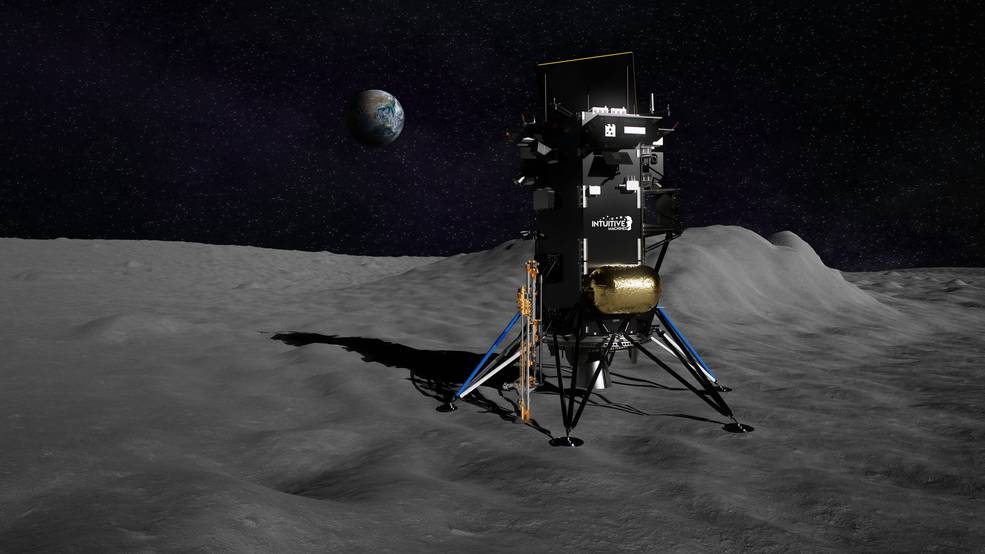

An artistic representation of the private Nova-C lunar lander built by Intuitive Machines on the moon’s surface. Image credit: Intuitive Machines
A private lunar lander has taken another major step toward its historic moonshot: the robotic Nova-C spacecraft is now enclosed inside the payload fairing of its SpaceX Falcon 9 rocket, gearing up for liftoff.
“As our combined teams closed the two fairing halves, I saw the lunar lander for the last time on Earth,” said Trent Martin, vice president for space systems at Intuitive Machines, the Houston company behind the lander, during a call with reporters.
The anticipated launch from Cape Canaveral Space Force Station on Florida’s Space Coast will occur between February 10 and February 12, as part of a three-day window. The actual date of the Nova-C’s lunar landing attempt is set for Feb. 22, according to Martin, and will not be affected by the flight day. Should the launch not take place in February, the next opportunity will be in March.
The upcoming mission, named IM-1, aspires to land Nova-C near the Malapert A impact crater, located within 10 degrees latitude of the moon’s south pole — a region likely to contain considerable amounts of water ice.
Odysseus, the Nova-C lander, is carrying six NASA science instruments under the agency’s Commercial Lunar Payload Services program, including a descent and landing sensor, a camera system, and a new type of technology to monitor fuel reserves. Other commercial payloads aboard IM-1 will cater to a wide range of customers.
To learn more about the mission and other lunar landers, you can explore Intuitive Machines here.
The voyage of the Nova-C will follow the trailblazing mission of Astrobotic’s Peregrine spacecraft, the first lunar lander supported by CLPS, which launched on January 8. The launch of the new Vulcan Centaur rocket was successful, but Peregrine experienced a critical fuel leak soon after deploying from the rocket’s upper stage. Find out more in the original article » …
Read More