

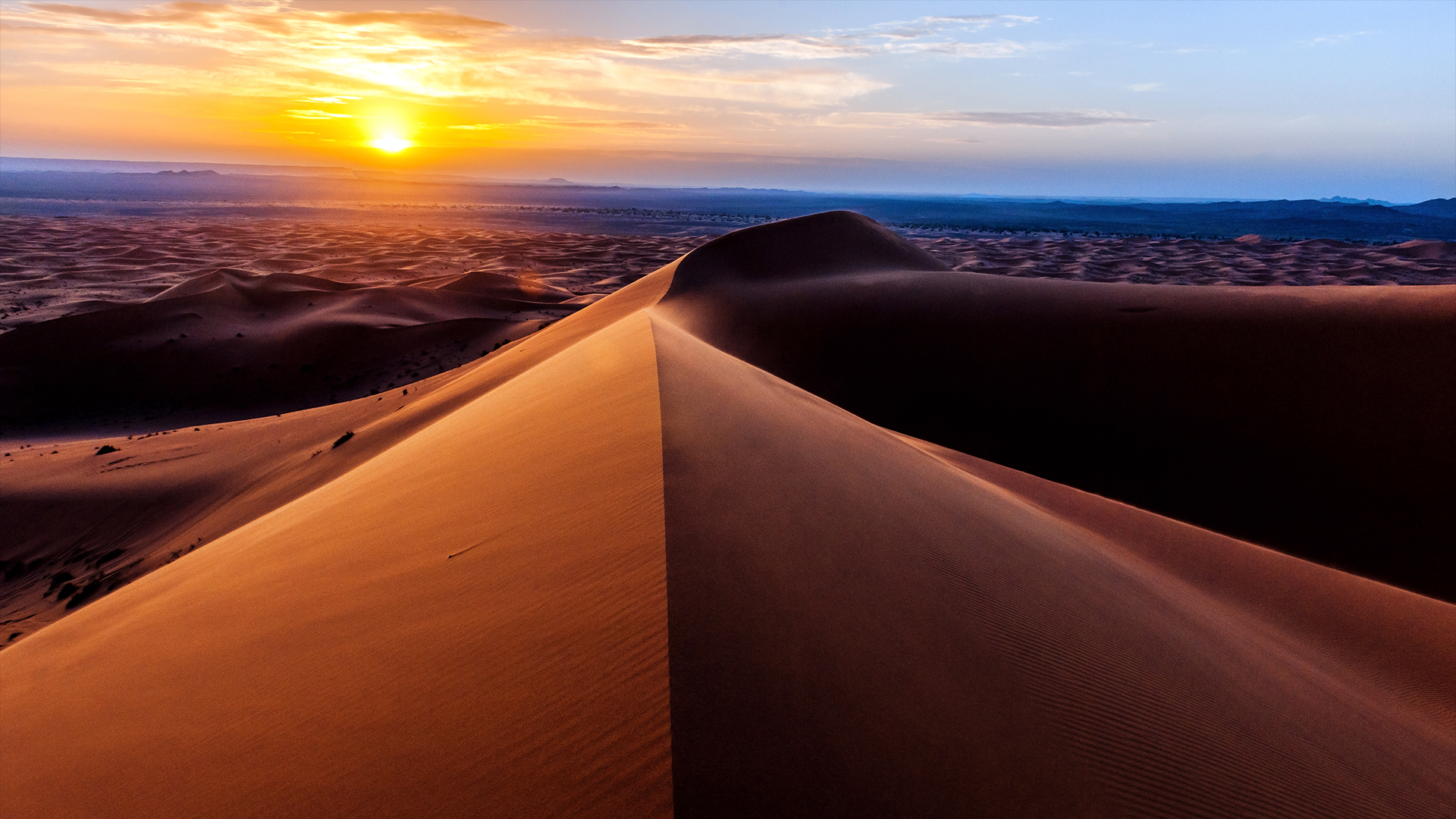

The Formation of a Remarkable Star Dune in the Sahara Desert
The discovery of a towering, star-shaped dune in Morocco’s Erg Chebbi dune field has captivated researchers due to its rapid formation in less than a thousand years. This unique geological formation, known as a star dune, was the subject of a recent study published in Scientific Reports on March 4.
Star dunes, distinguished by their multi-armed shapes, are considered the tallest dunes on the planet. These formations typically arise in regions where wind patterns shift direction seasonally, as explained by the National Park Service. Despite being a common occurrence worldwide, star dunes are rarely documented in the rock record, with only one confirmed ancient star dune dating back approximately 250 million years in Scotland.
Charles Bristow, a distinguished sedimentology professor at University College London, highlighted the challenges in identifying ancient star dunes, citing the lack of clear criteria for recognition. The scarcity of data on these formations is partly due to their remote locations, making in-depth analysis and exploration arduous tasks in the shifting sands of these dunes.
Current research sheds light on the complex processes that contribute to the formation of star dunes, offering valuable insights into the dynamic nature of desert landscapes. By unraveling the mysteries of these enigmatic structures, scientists aim to enhance their understanding of geological formations and the forces shaping our planet.Exploring the Youthful History of Morocco’s Lala Lallia Dune Field
The Lala Lallia dune, part of the Erg Chebbi dune field in Morocco, stands at an impressive height of approximately 330 feet (100 meters). This dune, with its local name known as Lala Lallia, has captured the interest of researchers aiming to unravel its geological history. Located amidst a popular tourist destination, Erg Chebbi, the accessibility to this dune provided researchers like Bristow, along with study co-author Geoff Duller from Aberystwyth University, the opportunity to gather valuable data.
Utilizing advanced ground-penetrating radar technology, the team delved beneath the surface of the dune to examine its internal layers. By detecting minute variations in sand grain sizes and water content, researchers could construct a detailed picture of the dune’s composition. Additionally, trenches were excavated to extract samples of long-buried sands rich in quartz, which accumulate radiation from natural sources while hidden from the surface. Through laser techniques, the researchers could analyze the accumulated radiation in the quartz to determine the last time the sand was exposed.
Surprisingly, the investigation uncovered that the Lala Lallia dune is relatively young, with a mere age of 900 years. The layers near the base of the dune, buried approximately 12,000 to 13,000 years ago, represent ancient dunes from the region. Following this period, there was an 8,000-year interval where sand deposition was minimal, coinciding with a warm, wet climate shift in the Sahara around 11,700 years ago.
The rapid formation of the Lala Lallia dune challenges conventional assumptions about the age of towering sand structures. This study sheds light on the dynamic nature of desert landscapes and the intricate interplay between climatic shifts and geological formations. By exploring the youthful history of this Moroccan dune, researchers gain valuable insights into the region’s geomorphological evolution.The Mystery of the Massive Saharan Star Dune Uncovered
For years, scientists have been puzzled by the existence of an enormous star dune in the Sahara Desert. This geological marvel has defied explanation, leading to various theories and hypotheses. However, recent research has shed new light on the origins of this unique formation, revealing a surprising discovery that challenges previous assumptions.
Revealing New Insights
The traditional belief was that the Saharan star dune was formed through wind and sand deposition over millions of years. While this theory seemed plausible, it failed to account for the dune’s sheer size and intricacies. Upon closer investigation, researchers discovered that the dune’s formation was actually influenced by a combination of geological factors that had not been previously considered.
Unexpected Factors at Play
Contrary to popular belief, the Saharan star dune was not solely the result of wind erosion and sediment accumulation. Instead, the dune’s shape and dimensions were primarily shaped by seismic activity and tectonic forces. This revelation challenges the conventional wisdom surrounding desert landforms and highlights the interconnectedness of geological processes.
Implications for Future Research
The discovery of the true origins of the Saharan star dune opens up new avenues for research in the field of geology. By reevaluating existing models and theories, scientists can gain a deeper understanding of how natural formations are created and evolve over time. This insight not only enriches our knowledge of the Earth’s geological history but also provides valuable context for studying other enigmatic landforms around the world.
Conclusion
In conclusion, the mystery of the massive Saharan star dune has finally been solved, thanks to groundbreaking research that uncovered unexpected geological factors at play. By challenging conventional explanations and embracing new perspectives, scientists have expanded our understanding of how unique landforms are shaped. This discovery serves as a reminder of the complexity and interconnectedness of Earth’s natural processes, setting the stage for further exploration and discovery in the field of geology.