

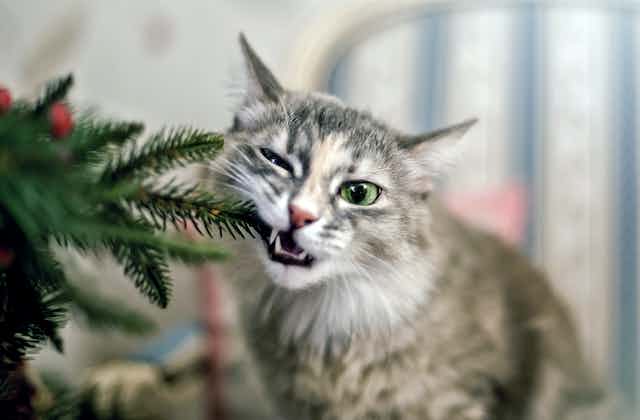

Every year, between 35 million and 50 million Christmas trees are purchased by Americans, with many more bringing out artificial trees for the season. In the U.S., about three-quarters of households usually have some kind of Christmas tree, according to surveys.
The question of which is more sustainable between real and artificial trees has sparked a big debate, with varying answers depending on who you ask and what factors you consider.
A more practical question to ask is: How can I find the most sustainable tree of the type I want to get?
As a forestry professor, I work on sustainability issues and can point out advantages and disadvantages of both cut and artificial trees. Here are some tips to consider for each.
(Credit: 10’000 Hours/DigitalVision via Getty Images) Cut Christmas trees require water and maintenance – and careful thought about disposal.
If you’re buying a live Christmas tree
When Christmas trees are alive and growing, they pull carbon dioxide from the air and use it as the building blocks of their wood. This process helps keep excessive carbon dioxide out of the atmosphere, which is a contributing factor to global warming.
This CO2 absorption process ceases once the tree is harvested. Eventually, the cut tree decomposes and releases the stored carbon back into the environment.
(Credit: USDA) Christmas tree farms like this one in Greencastle, Ind., can be found in almost every state.
However, the tree’s root systems will continue to store carbon for some time, and new trees are typically planted to continue the cycle.
So, how do you find the most sustainable live tree?
Consider the origin of the tree
If you live in Mississippi, like I do, buying a noble fir (Abies procera) likely means your tree came from the Pacific Northwest. This involves a long drive, which contributes to greenhouse gas emissions. However, when transported with several hundred trees, the individual tree’s emissions are relatively low.
(Credit: USDA) Douglas-firs grow primarily in the Western U.S.
The most common Christmas tree species varies by region: Douglas-fir is also common throughout the Mountain West. Scotch pine and balsam fir are regularly grown in the Great Lakes states. Fraser fir is popular in North Carolina as well as the Great Lakes. Leyland cypress and Virginia pine are common in the Southeast.
(Credit: USDA)
Balsam firs, also popular for Christmas trees, grow in the Great Lakes region, New England and Canada.
There are numerous other species grown locally. Of course, the lowest-impact cut tree is the one you cut from your own yard.
Seek out local nurseries that protect their soils from erosion and minimize harm to surface and groundwater from runoff that can include fertilizers or pesticides.
When it comes to disposing of your live tree, consider more eco-friendly methods
Interested in learning about more sustainable tree practices? Visit