

Powerful Santa Ana winds, near hurricane strength at times, swept down the mountains outside Los Angeles and pushed wildfires into several neighborhoods starting Jan. 7, 2025. Over 1,000 stuctures, mostly homes, had burned and at least five people had died by Jan. 8. Officials urged more than 100,000 residents to evacuate, but with the winds so strong, there was little firefighters could do to control the flames.
Jon Keeley, a research ecologist in California with the U.S. Geological Survey and adjunct professor at UCLA, explains what causes extreme winds like this in Southern California, and why they create such a serious fire risk.
What causes the Santa Ana winds?
The Santa Ana winds are dry, powerful winds that blow down the mountains toward the Southern California coast.
The region sees about 10 Santa Ana wind events a year on average, typically occurring from fall into January. When conditions are dry, as they are right now, these winds can become a severe fire hazard.
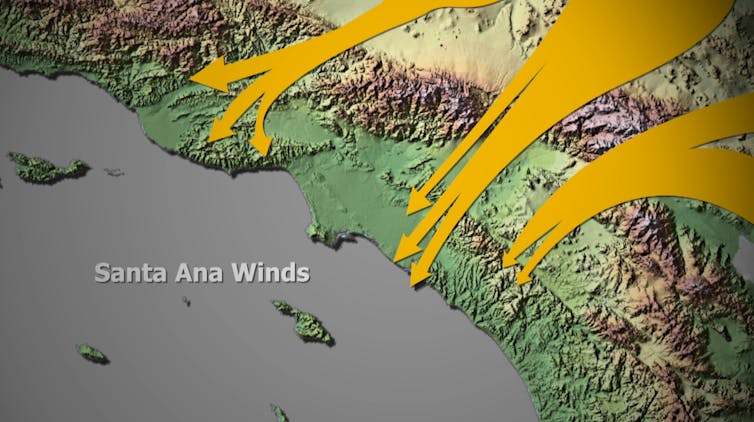
Santa Ana winds blow down the mountains toward the coast, drying and warming as they descend.
USGS
The Santa Ana winds occur when there is high pressure to the east, in the Great Basin, and a low-pressure system off the coast. Air masses move from high pressure to low pressure, and the more extreme the difference in the pressure, the faster the winds blow.
Topography also plays a role.
As the winds rush downslope from the top of the San Gabriel Mountains, they become drier and hotter. That’s a function of the physics of air masses. By the time the winds get to the point where the Eaton Fire broke out in Altadena on Jan. 7, it’s not uncommon for them to have less than 5% relative humidity, meaning essentially no moisture at all.
Canyons also channel the winds. I used to live in the Altadena area, and we would get days during Santa Ana wind events when the wind wasn’t present at all where we lived, but, a few blocks away, the wind was extremely strong.
These strong, dry winds are often around 30 to 40 mph. But they can be stronger. The winds in early January 2025 were reported to have reached 60 to 70 mph.
Why was the fire risk so high this time?
Typically, Southern California has enough rain by now that the vegetation is moist and doesn’t readily burn. A study a few years ago showed that autumn moisture reduces the risk of Santa Ana wind-driven fires.
This year, however, Southern California has very dry conditions, with very little moisture over the past several months. With these extreme winds, we have the perfect storm for severe fires.
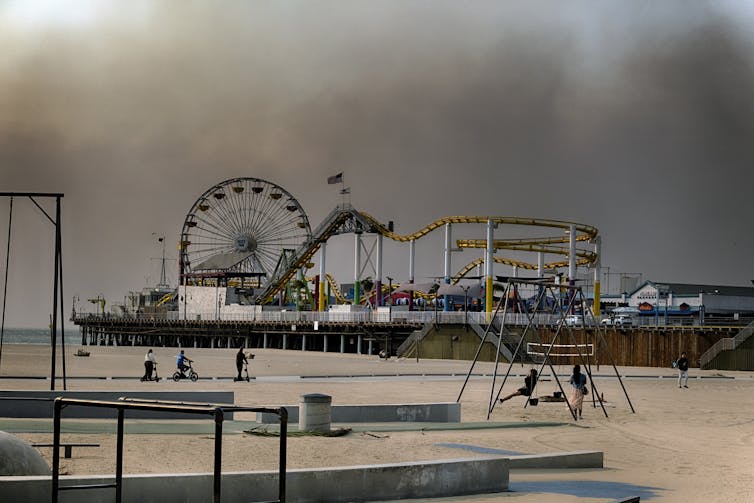
Dark smoke from the fires was evident from the Santa Monica, Calif., pier on Jan. 8, 2025.
AP Photo/Richard Vogel
It’s very hard to extinguish a fire under these conditions.