

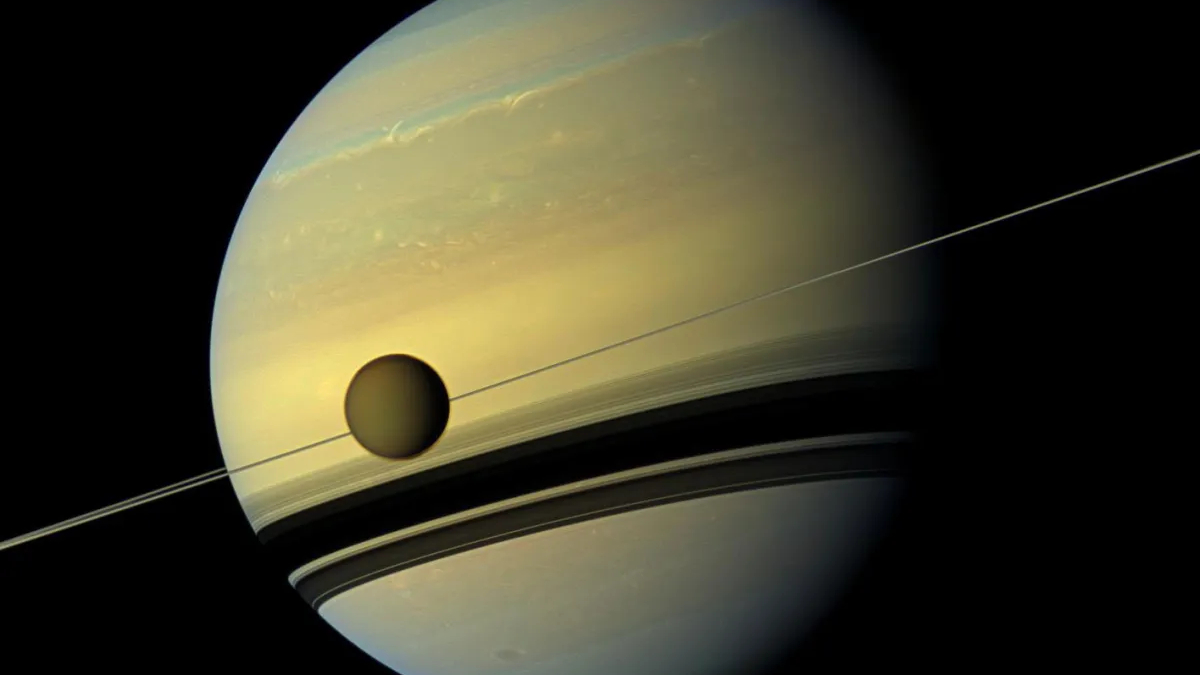

Is Titan’s Underground Ocean Inhospitable to Life?
Titan, Saturn’s largest moon, is known for its unique environment and fascinating chemistry. Despite having a surface covered in petrochemicals and organic molecules, Titan’s frigid temperatures of -179 degrees Celsius raise questions about the potential for life. Recent research suggests that Titan’s underground ocean, along with similar oceans in other icy moons, may lack the necessary organic chemistry for life to thrive.
The Challenging Conditions of Titan’s Ocean
The existence of Titan’s underground ocean, estimated to be about 100 kilometers deep, has sparked speculation about the possibility of life. However, Catherine Neish of Western University led a study that questioned this assumption. Neish’s team found that for life to exist in Titan’s ocean, a significant supply of organic molecules from the surface would need to reach the ocean through comet impacts.
The Organic Material Dilemma
While comet impacts can deliver organic material to the ocean, the rate of impacts is not sufficient to provide enough organic molecules to support life in Titan’s ocean. Neish’s team estimates that only a small amount of the simplest amino acid, glycine, reaches Titan’s ocean annually. This minimal supply of organics is far from enough to create a habitable environment in the vast ocean depths of Titan.
Potential Implications for Habitability
The findings of the study suggest that Titan’s underground ocean, and possibly the oceans of similar icy moons, may not be conducive to supporting life as previously thought. The lack of significant organic material reaching these subterranean oceans raises concerns about their habitability. While the idea of life existing on these moons is intriguing, the harsh realities of limited organic chemistry may hinder the prospects of life in these extreme environments.
In Conclusion
The research conducted by Neish and her team sheds light on the challenges that Titan’s underground ocean faces in terms of supporting life. While the mysteries of these icy moons continue to captivate scientists and enthusiasts alike, the current understanding points towards inhospitable conditions due to a lack of essential organic chemistry. This new perspective invites further exploration and investigation into the potential habitability of Titan and other similar celestial bodies in the outer solar system.