


Insights into Mathematical Problem Solving through Drawings
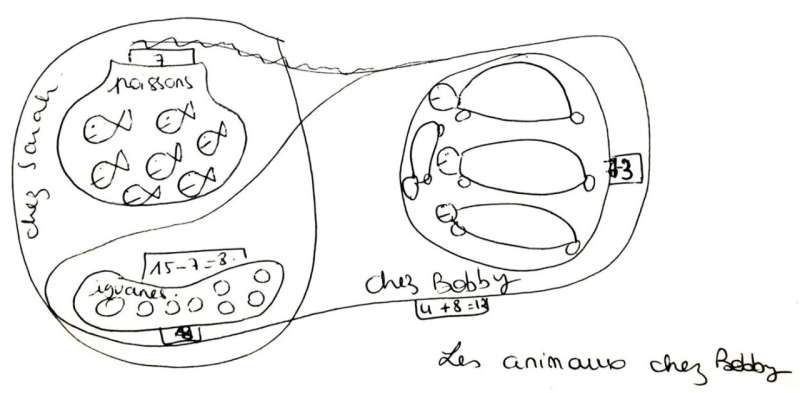
A recent study conducted by researchers from the University of Geneva (UNIGE), CY Cergy Paris University (CYU), and the University of Burgundy (uB) delved into the analysis of drawings produced by individuals of different age groups while navigating simple mathematical problems. The investigation revealed that distinct drawing styles were linked to more effective calculation strategies, regardless of the participant’s age.
The findings of this study, as documented in the journal Memory & Cognition, present novel implications for the pedagogy of mathematics, paving the way for enhanced learning techniques.
The Role of Mental Representation in Mathematics Education
Mathematics education commonly involves tackling small-scale problems that are grounded in real-life scenarios. For instance, students may need to compute the total amount of ingredients in a recipe or subtract expenses to determine their remaining funds after shopping. In these situations, learners are required to transform verbal prompts into systematic problem-solving approaches to identify the correct answers.
This process of converting words into computational strategies necessitates the formation of mental representations encompassing both mathematical elements, such as numbers and operations, and non-mathematical elements, like the context of the problem.
Understanding Dimensions in Mathematical Problem Solving
Enhancing comprehension of these mental representations holds the potential to elucidate the selection of calculation strategies. Through a collaborative effort between researchers from UNIGE, CYU, and uB, a study was conducted involving individuals aged 10 and adults. Participants were tasked with resolving elementary problems with an emphasis on minimizing the number of calculation steps.
Subsequently, the individuals were instructed to create drawings or diagrams elucidating their problem-solving methodologies for each scenario. Certain problems focused on the cardinal properties of numbers—such as the quantity of items in a set—while others emphasized their ordinal properties, referring to their position in a sequential arrangement.
Instances of the former involved scenarios like determining the total number of marbles or fishes in possession of different individuals, while the latter revolved around scenarios related to durations or distances covered during travel.
Despite both types of problems being solvable through a 3-step approach or a single calculation, their underlying mental structures differ significantly. The researchers aimed to ascertain whether the type of mental representations could forecast the calculation strategies—be it in 1 step or 3 steps—adopted by individuals while solving these problems.
For further information, please refer to the original publication here.